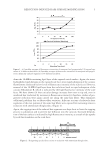
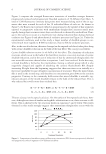
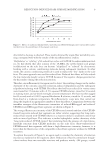
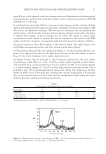
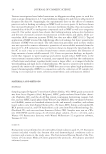
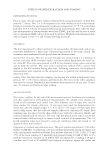
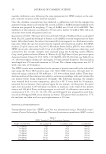
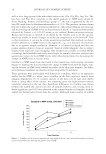
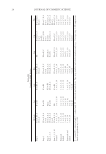
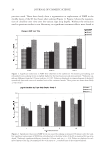
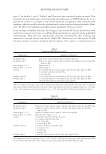
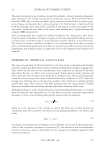
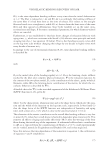
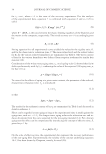
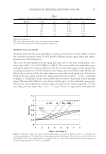
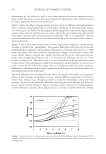
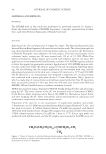
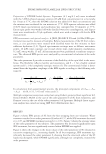
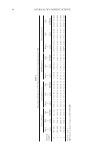
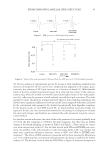
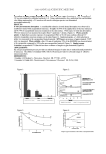
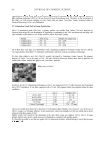
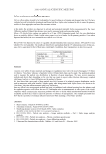
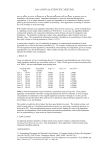
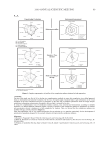
VISCOELASTIC BENDING RECOVERY OF HAIR 35 MODEL CALCULATIONS To demonstrate the two principal effects of aging on hair fi ber recovery, Figure 1 shows the calculated recovery curves at 65% RH for different initial aging times and experi- mental times well beyond t=tA. The curves for the hypothetical non-aging hair start close to the time-independent, com- mon value of R0=0.18 at 65% RH (see Table I). The curves follow the path that is pre- scribed by equation 8 and are shifted on the log λ scale with respect to the aging time according to equation 10. If the material is non-aging, recovery will be relatively fast and half of the initial set will be lost after about ten times the initial aging time. Deviations between the non-aging and the real, aging material occur at time t 1/10tA, as marked in Figure 1. Comparison of the curves shows that recovery is drastically slowed through aging. Though small differences are observed with respect to the individual aging time, all recovery curves approach a narrow range of fi nal recovery values around Rf ≈ 0.6 for very long recovery times (log t 8, t 3 years). This is in agreement with practical Table I Arithmetic Means for K=ΔB/B∞ and for the Reduced, Characteristics Relaxation Times, as log τr RH (%) w (%) K log τr R0 15 4.0 5.9 0.53 0.14 33 7.8 6.2 0.15 0.14 45 9.5 6.2 0.22 0.14 65 13.0 4.7 0.031 0.18 74 15.1 3.3 −0.13 0.23 82 17.3 2.4 −0.01 0.29 Taken from reference 1. RH is the relative humidity and w the water content of hair. R0 is the value of the initial recovery, given by equation 9. Figure 1. Recovery curves for various, initial aging times, as indicated. Broken curves (---) represent the recovery performance of the hypothetical, non-aging material and relate to the log λ scale. Solid curves show the behavior of the real, aging material, relating to the log t scale. Deviations between the two groups of curves become apparent at t1/10 tA, as marked.

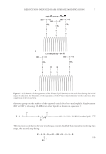
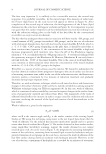
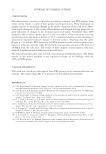
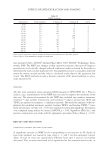
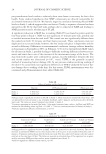
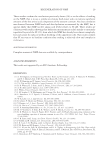
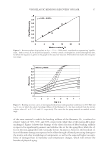
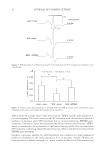
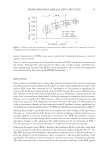
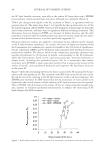
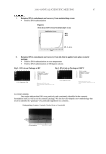
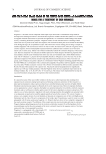
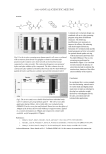
JOURNAL OF COSMETIC SCIENCE 36 observations by the authors as well as with those reported by various informal sources, where water-waved hair tresses have been hanging in laboratories with constant climate for years, apparently without losing their set. Figure 2 shows the effects of aging on hair recovery curves at different relative humidities and a common, initial aging time (tA=100 min), calculated on the basis of the param- eter values given in Table I for non-aging and for aging hair, respectively. Again, aging greatly delays recovery, and the recovery values, which the curves apparently approach for long times, increase with increasing relative humidity. This is in agreement with the practical observation that the set of a hairstyle based on water waving decreases with in- creasing humidity. Figures 1 and 2 show that for long times recovery approaches an apparent constant value. In order to calculate the “equilibrium,” the apparent fi nal value of recovery, Rf, for the dif- ferent humidity conditions, and for all practical purposes a very long time (log t=11, t3000 years), was chosen. The values for Rf are summarized in Figure 3 versus water content. The values closely follow a straight line, which describes the loss of set with increasing hu- midity. The straight line fi t predicts Rf =0.32 for dry hair and total recovery at a water content of about 25%. The latter value is in good agreement with the maximum water content of hair. The extrapolation validates the assumption underlying the calculations that total recovery will be achieved in water, that is, at conditions above the glass transition. Furthermore, the observation is in good agreement with the practical observation that wet- ting of hair removes the water wave. The tools that have been developed for the above calculations also enable as to assess the effects of fi ber damage on bending recovery namely, DSC-investigations (21,22) have shown that, damage, e.g., through oxidative or reductive processing, is fi rst and most strongly imparted to the fi laments. Plausibly expecting that such damage will lower the elastic modulus of the fi laments, Figure 4 shows recovery curves for an undamaged hair at 65% RH and a constant, short aging time of tA=10 min, together with the recovery Figure 2. Recovery curves at constant aging time (tA=100 min) and for different relative humidities (20°C), as marked for the solid curves for the aging material. The broken lines show the related curves, expected for non-aging hair.
Purchased for the exclusive use of nofirst nolast (unknown)
From: SCC Media Library & Resource Center (library.scconline.org)