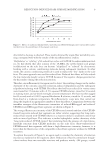
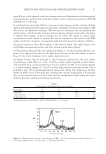
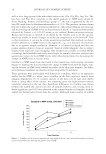
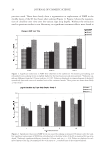
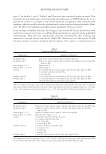
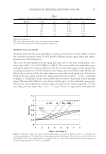
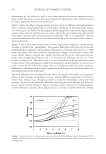
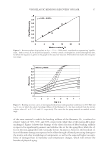
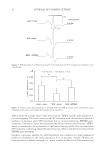
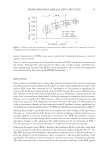
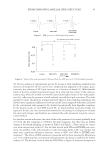
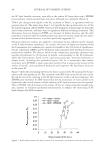
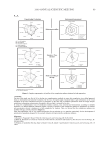
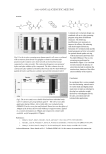
VISCOELASTIC BENDING RECOVERY OF HAIR 37 of the same material in which the bending stiffness of the fi laments, B∞, is reduced to relative values of 70%, 50%, and 30%, respectively, while that of the matrix ΔB is kept unchanged. Figure 4 shows that damage to the elastic fraction of fi ber bending stiffness is expected to signifi cantly promote and stabilize the set for the aging fi ber, while the ef- fect in the non-aging fi ber will eventually be lost. In practice, however, the benefi cial ef- fects of fi lament damage are expected to be offset through collateral processing damage to the matrix and other morphological components, as well as the expected higher suscepti- bility of damaged hair to humidity and temperature changes, which will remove the benefi ts of physical aging. Figure 3. Recovery values of aging hair at log t = 11 (t 3000 years), considered as representing “equilib- rium,” fi nal recovery, Rf, for all practical purpose, vs water content. A straight line is fi tted through the data, for which the equation is given on the graph in the usual x/y-notation. The broken line marks the extrapola- tion range. Figure 4. Bending recovery curves of non-aging (broken lines) and aging hair (solid lines) at 65% RH and tA=10 min, in which the elastic bending stiffness of the fi laments, B∞, has been reduced from the initial, relative value of 1 to 0.7, 0.5, and 0.3, respectively. The curves for the aging material are marked accord- ingly.

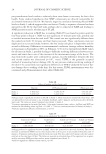
JOURNAL OF COSMETIC SCIENCE 38 CONCLUSIONS The model calculations show, in agreement with practical observations, that the relative humidity of the environment as well as hair damage have an important infl uence on the performance of a non-permanent hairstyle on the basis of water waving. However, irre- spective of the environmental conditions, as long as they stay below the glass transition, it is nevertheless the phenomenon of physical aging that makes water waving a feasible and practically successful process for hair styling. REFERENCES (1) F.-J. Wortmann, M. Stapels, and L. Chandra, Humidity dependent bending recovery and relaxation of human hair, J. Appl. Polym. Sci., 113, 3336–3344 (2009). (2) M. Feughelman, Mechanical Properties and Structure of Alpha-Keratin Fibers (University of New South Wales Press, Sydney, Australia, 1997). (3) D.A.D. Parry and P. Steinert, Intermediate fi laments: Molecular architecture, assembly, dynamics and polymorphism, Quarterly Rev. Biophys., 32, 99–187 (1999). (4) H. Zahn, F.J. Wortmann, G. Wortmann, K. Schaefer, R. Hoffmann, and R. Finch, “Wool,” in Ullmann’s Encyclopedia of Industrial Chemistry, 6th ed. (Wiley-VCH, Weinheim, Germany, 2003), Vol.39. (5) F.J. Wortmann, B.J. Rigby, and D.G. Phillips, Glass transition temperature of wool as a function of regain, Text. Res. J., 54, 6–8 (1984). (6) F.J. Wortmann, M. Stapels, R. Elliott, and L. Chandra, The effect of water on the glass transition of human hair, Biopolymers, 81, 371–375 (2006). (7) B.M. Chapman, The aging of wool. Part I: Aging at various temperatures, J. Text. Inst., 66, 339–342 (1975). (8) F.J. Wortmann and S. DeJong, Analysis of the humidity-time superposition for wool fi bers, Text. Res. J., 55, 750–756 (1985). (9) F.-J. Wortmann and I. Souren, Extensional properties of human hair and permwaving performance, J. Soc. Cosmet. Chem., 38, 125–140 (1987). (10) F.-J. Wortmann and N. Kure, Bending relaxation properties of human hair and permwaving perfor- mance, J. Soc. Cosmet. Chem., 41, 123–139 (1990). (11) B.M. Chapman, The rheological behaviour of keratin during the aging process, Rheol. Acta, 14, 466– 470 (1975). (12) E.F. Denby, A note on the interconversion of creep, relaxation and recovery, Rheol. Acta, 14, 591–593 (1975). (13) J.D. Ferry, Viscoelastic Properties of Polymers ( John Wiley & Sons New York, 1980). (14) L.C.E. Struik, Physical Aging in Amorphous Polymers and Other Materials (Elsevier, Amsterdam, 1978), Chapter 4. (15) F.J. Wortmann, The viscoelastic properties of wool and the infl uence of some specifi c plasticizers, Colloid Polym. Sci., 265, 126–133 (1987). (16) C.A. Angell, K.L. Ngai, G.B. McKenna, P.F. McMillan, and S.W. Martin, Relaxation in glassforming liquids and amorphous solids, J Appl. Phys., 88, 3113–3157 (2000). (17) J.W.S. Hearle, B.M. Chapman, and G.S. Senior, The interpretation of the mechanical properties of wool, Appl. Polym. Symp., 18, 775–794 (1971). (18) M. Feughelman and M. Druhala, The lateral mechanical properties of alpha-keratin, Proc. 5th Int. Wool Text. Res. Conf. Aachen, II, 340–349 (1976). (19) F.J. Wortmann, A. Hullmann, and C. Popescu, Water management of human hair, IFSCC Mag., 10, 317–320 (2007). (20) B.M. Chapman, Linear superposition of time-variant viscoelastic responses, J. Phys. D: Appl. Phys., 7, L185–L188 (1974). (21) F.-J. Wortmann, C. Popescu, and G. Sendelbach, Nonisothermal denaturation kinetics of human hair and the effects of oxidation, Biopolymers, 83, 630–635 (2006). (22) F.J. Wortmann, C. Popescu, and G. Sendelbach, Effects of reduction on the denaturation kinetics of human hair, Biopolymers, 89, 600–605 (2008).
Purchased for the exclusive use of nofirst nolast (unknown)
From: SCC Media Library & Resource Center (library.scconline.org)