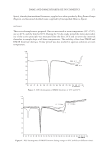
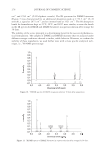
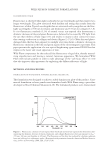
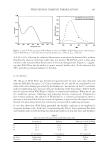
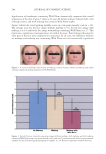
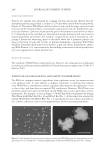
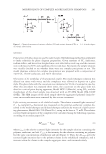
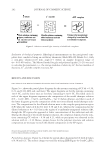
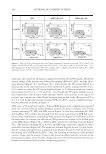
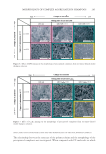
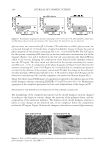
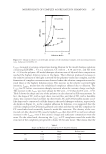
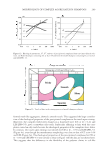
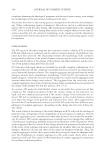
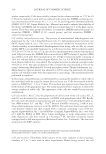
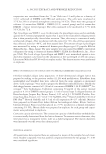
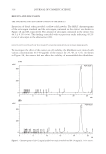
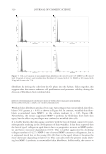
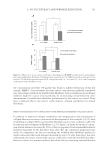
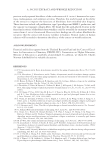
JOURNAL OF COSMETIC SCIENCE 276 cm−1 and 2782 cm−1 (C–H aliphatic stretch). The IR spectrum for DMAE bitartrate (Figure 7) was characterized by an additional absorption peak at 1732.3 cm−1 (C=O stretch), a signal at 2975 cm−1, and an intense band at 3321 cm−1. The IR absorption bands for formulations kept at 25°C, 40°C, and 60°C were similar, as were the bands in the IR spectra for DMAE and DMAE bitartrate in aqueous solution after storage for 30 days. The stability of the active principle is a determining factor for the success of pharmaceu- tical formulations. The samples of DMAE and DMAE bitartrate that we analyzed under different storage conditions showed a similar, stable behavior. However, to confi rm the stability of these ingredients, we used further tests with a more specifi c analytical tech- nique, i.e., 1 H-NMR spectroscopy. Figure 10. 1 HNMR spectra of DMAE in aqueous solution 30 days after preparation. Figure 11. 1 HNMR spectra of DMAE bitartrate in aqueous solution after storage for 30 days.

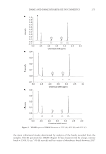
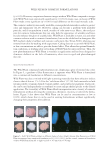
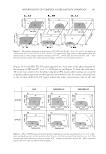
DMAE AND DMAE BITARTRATE IN COSMETICS 277 NUCLEAR MAGNETIC RESONANCE SPECTROSCOPY Nuclear magnetic resonance is one of the most specifi c methods for determining the structure of active principles. The 1 H-NMR spectra of DMAE and DMAE bitartrate alone are displayed in Figures 8 and 9 and the corresponding spectral data are given below. Figure 8A shows signals for DMAE at 2.14, 2.4, and 3.61, which were assigned to 2CH3, CH2–N and CH2–O, respectively. Figures 8B and 8C illustrate the same signals for samples of DMAE heated to 40°C and 60°C. Similarly, Figure 9A shows signals for DMAE bitartrate at 2.83 and 3.81, which were assigned to the same hydrogens as in the sample of free-base DMAE. An additional signal at 4.42 was assigned to the CH–COO. Heating the samples to higher temperatures did not affect the pattern of signals (Figures 9B and 9C). When we compared the 1 H-NMR spectra for the DMAE alone and in aqueous solu- tion after storage for 30 days (Figures 10,11) we found no differences. Identical results were also obtained in samples heated to 40°C and 60°C. Our 1 H-NMR results for DMAE and DMAE bitartrate were similar, and confi rmed the IR spectroscopy and DSC fi ndings. CONCLUSION We observed no changes in any of the physicochemical activities of DMAE and DMAE bitartrate with storage time or temperature. Our results show that both the free base and the bitartrate salt can be used in the preformulation stage to prepare liquid formulas containing this active principle. ACKNOWLEDGMENTS Part of this work was supported by the Junta of Andalucia, Project of Excellence FQM 3993-2008. We thank K. Shashok for translating signifi cant parts of the original manu- script into English. REFERENCES (1) G. C. Singh, M. C. Hankins, A. Dulku, and M. B. Kelly, Psychosocial aspects of botox in aesthetic surgery, Aesthetic Plast. Surg., 30, 71–76 (2006). (2) M. J. Tribo, Razones de ser de la psicodermatología, Piel, 1(2), 51–53 (2006). (3) G. Schneider, G. Driesch, G. Heuft, S. Evers, A. Lugert, and S. Städert, Psychosomatic cofactors and psychiatric comorbidity in patients with chronic itch, Clin. Expl. Dermatol., 31(6), 762–765 (2006). (4) T. Loti, B. Bianchi, and E. Panconesi, Neuropeptides and skin disorders. The new frontiers of neuroen- docrine-cutaneous immunology, Int. J. Dermatol., 38, 673–675 (1999). (5) J. L. Parra and L. Pons, “La piel y sus anejos como sustrato vivo de la cosmetología. El tejido cutáneo. Inervación cutánea,” in Ciencia Cosmética, Bases Fisiológicas y Criterios Prácticos (Consejo General de Colegios Ofi ciales de Farmacéuticos, Madrid, 1995), pp. 149–150. (6) I. Uhoda, N. Faska, and C. Robert, Split face study on the cutaneus tensile effect of 2-dimethylamino- ethanol (deanol) gel, Skin Res. Technol., 8(3), 164–167 (2002).
Purchased for the exclusive use of nofirst nolast (unknown)
From: SCC Media Library & Resource Center (library.scconline.org)