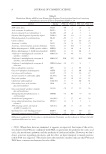
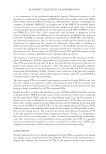
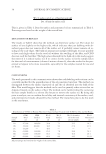
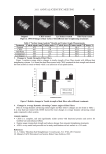
JOURNAL OF COSMETIC SCIENCE 30 Wt.% surface oil× wt. of hair for total oil wt. of hair for surface oil This is given in Table I. Data for surface and penetrated oil are summarized in Table I. Percentages are based on the weight of the treated hair. DISCUSSION OF RESULTS The results in Table I show that the method can determine surface oil. The values for surface oil are slightly on the higher side, which indicates that just dabbing with ab- sorbent paper does not remove all of the surface oil. It probably cannot remove oil re- siding at the scale edges. The bulk oil amounts are unexpectedly high. It is not possible to have such high values for the total oil without the swelling of the fi ber, and CNO does not swell the hair fi ber. The high values obtained for the bulk oil in this study suggest that most of it is indeed surface oil. If we correct for the surface oil in the sample taken for the total oil measurement (column 4 minus column 6), then the results for the pen- etrated oil appear to be more reasonable, especially for the samples treated for one and six hours. CONCLUSIONS The work presented in this communication shows that radiolabeling with tritium can be a suitable method for the quantifi cation of the oil penetrated into hair. The method can distinguish between the surface deposited oil and the oil absorbed into the bulk of the fi ber. This would suggest that the method can be used to quantify other actives that are deposited mainly on the surface of hair. The method can be further refi ned by extracting the hair sample briefl y in a solvent like hexane to remove the surface oil. By doing this prior to analysis, we can confi rm the validity and internal consistency of the surface, total, and penetrated oil results obtained by this method. The researchers plan to do this work in the near future. Table I Distribution of TCNO in Human Hair (wt.% based on hair) Treated with TCNO for One and Six Hours Sample name CPM Total oil CPM Surface oil Wt.% Total oil Wt.% Surface oil Wt.% of surface oil in the total oil test sample Wt.% Penetrated oil 1A 47,100 106,458 50.0 7.1 35.5 14.5 1B 45,300 80,000 48.5 5.4 27.0 21.5 1C 45,200 — 48.4 — — — 6A 61,000 116,000 65.3 7.8 39.0 26.3 6B 62,000 138,000 66.4 9.2 46.0 20.4 6C 62,000 133,000 66.4 8.9 44.5 21.91 All percentages are based on the weight of the treated hair.

COCONUT OIL PENETRATION INTO HAIR 31 ACKNOWLEDGMENTS The authors thank Dr. Harishchandra and Dr Meenakshi Nikam, BRIT, Bhabha Atomic Research Centre (BARC), Mumbai, for help and support in conducting these experiments. REFERENCES (1) S. B. Ruetsch, Y. K. Kamath, A. S. Rele, and R. B. Mohile, Secondary ion mass spectrometric investiga- tion of penetration of coconut and mineral oils into human hair fi bers: Relevance to hair damage, J. Cosmet. Sci., 52, 169–184 (2001). (2) S. Hornby, Y. Appa, S. B. Ruetsch, and Y. Kamath, Mapping penetration of cosmetic compounds into hair fi bers using time of fl ight secondary ion mass spectroscopy (TOF-SIMS), IFSCC Magazine, 8, 99–104 (2005). (3) K. Keis, D. Persaud, Y. K. Kamath, and A. S. Rele, Investigation of penetration abilities of various oils into human hair fi bers, J. Cosmet. Sci., 56, 283–295 (2005).
Purchased for the exclusive use of nofirst nolast (unknown)
From: SCC Media Library & Resource Center (library.scconline.org)