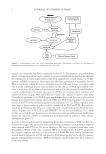
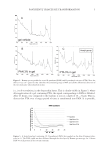
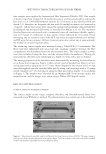
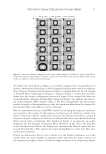
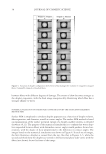
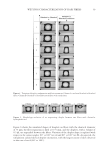
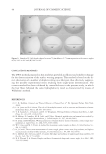
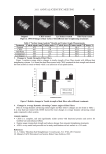
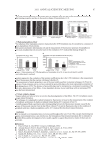
J. Cosmet. Sci., 63, 33–41 (January/February 2012) 33 Differential wetting characterization of hair fi bers ABE VAYNBERG, MARK STUART, and XIANG-FA WU, Ashland Inc., 5200 Blazer Parkway, Dublin, OH 43017 (A.V., M.S.), and Department of Mechanical Engineering and Applied Mechanics, North Dakota State University, Fargo, ND 58108-6050 (X.-F.W.). Accepted for publication August 31, 2011. Synopsis Surface wetting is one of the key properties of human hair used to indicate the extent of chemical/mechanical damage and the outcome of conditioning treatment. Characterization of hair wetting property is a challeng- ing task due to the non-homogeneous nature of hair fi bers and the requirement for sensitive equipment. Motivated by these considerations, we developed a new methodology, termed a differential wetting charac- terization (DWC), which would allow rapid and reliable characterization of the wetting property of hair fi - bers. This method is based on observation of a number of droplets suspended on a pair of parallel fi bers stretched in a horizontal plane. The wetting behavior of the fi bers can be deduced from the shape assumed by the droplets. When the wetting properties of the two hair fi bers are identical, the droplets suspended between the fi bers assume a symmetric confi guration. In contrast, on the fi bers with dissimilar wetting characteristics, the droplets will assume a skewed confi guration towards a more hydrophilic fi ber. This makes it possible to differentiate the hydrophobicities of the tested fi bers. In this paper it is demonstrated that the proposed DWC method is capable of differentiating the changes in wetting property of hair surfaces in response to either chemical or physical treatment. Results of the paper indicate that the DWC method is applicable for broad wetting differentiation of various fi bers. INTRODUCTION The surface of undamaged, so-called virgin, hair is naturally hydrophobic due to the ex- istence of 18-methyl-eicosanoic acid in the outmost layer of epicuticle (1). This acid is covalently bound via a thioester linkage to the cell membrane complex (2) and can be removed as a result of weathering and chemical treatment. Typically, the loss of 18-methyl- eicosanoic acid is accompanied by noticeable coarsening of hair to the touch and an in- crease in combing forces in both wet and dry states. Cosmetic treatments aim to alleviate the negative effect of hair damage. For instance, treatment of damaged hair with silicones and quaternary surfactants can restore both the manageability and hydrophobicity of hu- man hair. Improvement of the hair wetting property has been the concern of cosmetic chemists. Consequently, a number of techniques have been practiced in determining the wetting properties of human hair fi bers (3–10). Address all correspondence to Abe Vaynberg at kvaynberg@ashland.com.
Purchased for the exclusive use of nofirst nolast (unknown)
From: SCC Media Library & Resource Center (library.scconline.org)