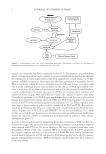
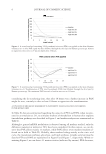
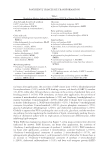
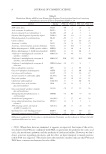
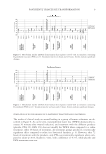
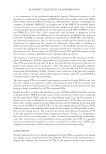
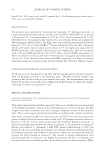
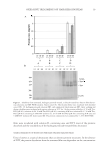
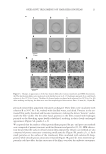
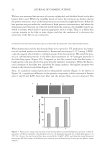
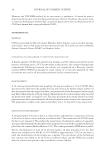
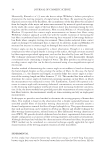
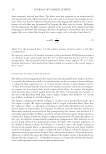
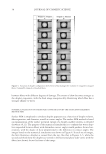
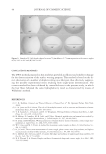
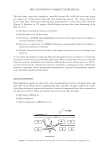
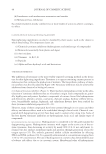
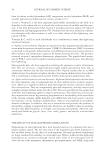
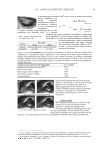
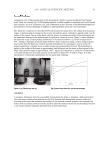
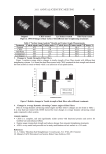
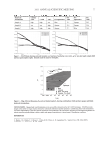
JOURNAL OF COSMETIC SCIENCE 38 between fi bers with different degrees of damage. The extent of skew becomes stronger as the droplet evaporates, with the fi nal image unequivocally illustrating which fi ber has a stronger affi nity to water. NUMERICAL VALIDATION OF THE DROPLET CONFIGURATION BY THE SURFACE FINITE ELEMENT METHOD (FEM) Surface FEM is employed to simulate droplet appearance as a function of droplet volume, fi ber separation, and diameter, as well as contact angles. The surface FEM method is based on minimization of the surface potential energy of a droplet-on-fi ber system, as detailed elsewhere (8,12). The purpose of the numerical simulations is to confi rm that water drop- lets suspended between fi bers with dissimilar contact angles would produce skewed ori- entation, with the degree of skew proportional to the difference in contact angles. The images based on the numerical simulations are shown in Figure 6. In each set of images, the fi rst illustrates a droplet as viewed from the top, like that in Figures 2–5, while the second and third show the droplets as viewed in the horizontal plane (side view), with the fi bers (not shown) located in front of the image. Figure 3. Variation of droplet confi guration with extent of hair damage (II). Column A: stripped vs stripped fi bers. Column B: stripped vs bleached fi bers.

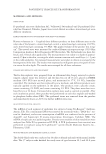
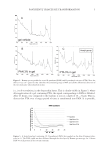
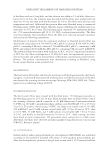
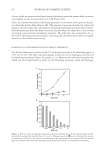
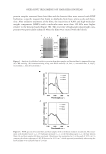
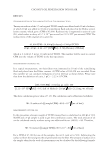
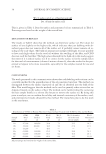
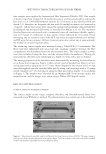
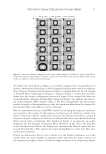
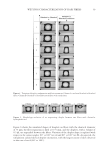
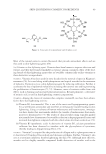
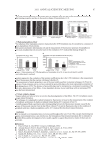
WETTING CHARACTERIZATION OF HAIR FIBERS 39 Figure 5. Morphology evolution of an evaporating droplet between two fibers with dissimilar hydrophobicities. Figure 6 shows the simulated shapes of droplets on fi bers with the identical diameter of 75 μm the fi ber separation is fi xed at 0.75 mm, and the droplets, with a volume of 0.3 μl, are suspended between the fi bers. Variation of the droplet shape is explored with respect to the contact angles: 60° vs 100° (set A) and 80° vs 100° (set B). As expected, the simulations yielded skewed droplet orientation, with the largest extent of skew observed in the case of set A (60° vs 100°). Figure 4. Variation of droplet confi guration with hair treatment. Column A: one-hour bleached vs bleached fi bers. Column B: bleached vs bleached/treated fi bers with conditioner.
Purchased for the exclusive use of nofirst nolast (unknown)
From: SCC Media Library & Resource Center (library.scconline.org)