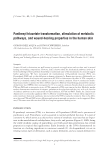
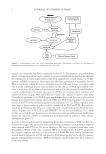
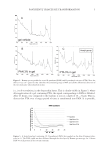
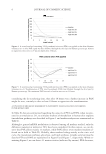
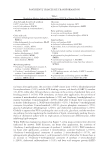
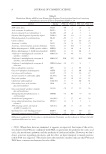
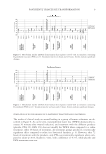
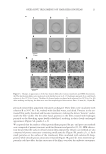
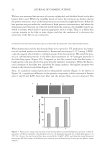
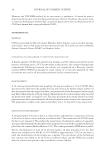
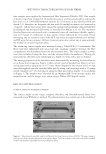
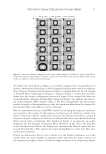
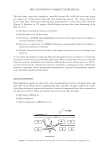
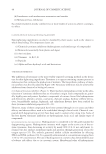
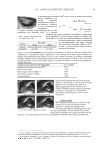
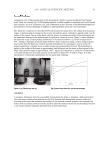
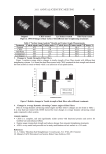
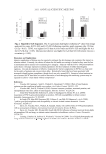
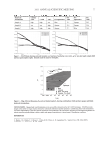
JOURNAL OF COSMETIC SCIENCE 36 three randomly selected hair fi bers. The fi bers were fi rst prepared on an aluminum foil and neutralized with a Milty Zerostat* anti-static gun to eliminate the possible electro- static effect that may be induced in the processes of packaging and handling. The circum- ference of each fi ber was determined by dipping the fi ber into iso-octane. Following this determination, the fi ber segments exposed to the iso-octane were trimmed and then submerged in DI water. By assuming that the circumference of hair fi bers does not vary appreciably over a short fi ber length, the contact angle can be calculated such that (1): T J cos( ) F L (1) where F is the measured force, γ is the surface tension of water, and L is the fi ber circumference. As expected, removal of 18-methyl-eicosanoic acid by methanolic KOH solution resulted in a decrease in the contact angle from 88° ± 2° of the virgin hair down to 83° ± 2° (the stripped hair). The bleached hair fi bers exhibited a lower contact angle of 78° ± 1°. Con- ditioner treatment of the bleached hair fi bers yielded an increase in the contact angle to 83.5° ± 0.2°. DIFFERENTIAL WETTING CHARACTERIZATION The differential wetting property was characterized by placing DI water droplets between two parallel hair fi bers stretched in a horizontal plane on the test stage as shown in Figure 1, where the fi ber separation was ∼0.75 mm and the volume of water droplets was 0.2 ∼0.4 μl. It was found that the majority of the droplets assumed a symmetrical confi gura- tion against the horizontal plane, which transected the fi bers. In contrast, the droplets with relatively large volume sagged below the hair fi bers. Occasionally, for example, in the case of the hair fi bers with large contact angles, droplets were found to “sit” on the top of fi bers, as shown in cell A6 in Figure 2. The droplet confi gurations shown in Figure 2 are three sets of parallel fi bers made up of (A) virgin vs virgin, (B) virgin vs stripped, and (C) virgin vs bleached fi bers. Note that the “reference” fi bers, i.e., the fi bers in reference to which the hydrophobicities are deter- mined, appear as bottom fi bers in all images. In addition, both the reference and the test fi bers were randomly extracted from the corresponding hair tresses, and therefore it is reasonably assumed that the fi bers carried the average wetting property. Images shown in column A of Figure 2 show the droplet confi gurations between two virgin hair fi bers. In this case, the droplets assumed nearly symmetrical confi gurations. This indicates, as ex- pected, nearly identical wetting properties of the two fi bers. The “unusual” appearance of the droplet as shown in image A6 of Figure 2, as noted, is due to the droplet resting on the top of the parallel fi bers—a phenomenon occasionally observed with larger droplets on fi bers with higher contact angles. Columns B and C of Figure 2 show the droplet con- fi gurations being progressively skewed. This indicates the sequence of decreasing hydro- phobicity, in which the virgin hair fi bers exhibited the highest extent of hydrophobicity, followed by the stripped (i.e., 18-methyl-eicosanoic acid removed) and bleached hair fi - bers, in full agreement with contact angle measurements.

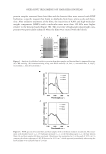
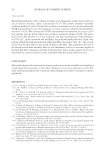
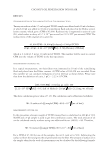
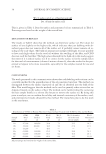
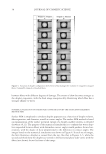
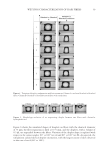
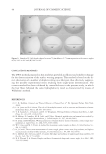
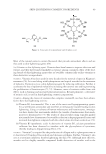
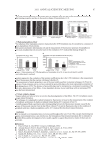
WETTING CHARACTERIZATION OF HAIR FIBERS 37 To validate the trend shown in Figure 2, we further considered the wetting behavior of another combination of hair fi bers, in which stripped hair fi bers were used as the reference fi bers. Images of droplets wetting between stripped vs stripped fi bers (set A) and stripped vs bleached fi bers (set B) appear in Figure 3. Images in Figure 3 confi rm the conclusion drawn from the droplet confi guration observed in Figure 2 that stripped hair fi bers are more hydrophobic than bleached hair fi bers. Images in Figure 3 also examine the sensitiv- ity of the proposed DWC method. Thus, it has been demonstrated that the present method is capable of distinguishing not only the virgin hair fi bers from the damaged fi - bers but also fi bers with different extents of damage. Next we demonstrate the use of the DWC method in evaluating the impact of condition- ing treatment. Once again, for the purpose of comparison and validation, column A in Figure 4 shows the droplet confi guration between two bleached hair fi bers column B shows the droplet confi guration between the bleached hair fi bers and the bleached hair fi bers treated with a conditioner. The droplets in Figure 4, as expected, are nearly symmetric for the bleached vs bleached fi bers. However, in the case of the bleached vs the bleached/treated fi bers, the droplets are systematically skewed toward the un- treated bleached fi ber. This implies the larger hydrophobicity of the hair fi ber after conditioner treatment. Finally, we demonstrate that in case of doubt as to the droplet orientation, one could simply allow the water droplets to evaporate while observing the shape evolution of the evaporating droplets. Figure 5 shows the shape evolution of an evaporating droplet Figure 2. Variation of droplet confi guration with extent of hair damage (I). Column A: virgin vs virgin fi bers. Column B: virgin vs stripped fi bers. Column C: virgin vs bleached fi bers. Note that the reference fi ber (virgin in this case) appears at the bottom of each image.
Purchased for the exclusive use of nofirst nolast (unknown)
From: SCC Media Library & Resource Center (library.scconline.org)