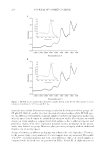
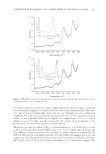
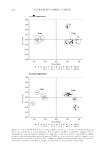
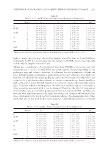
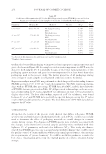
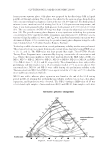
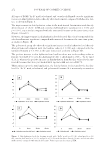
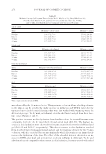
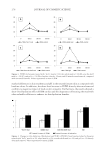
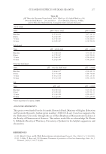
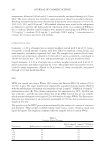
JOURNAL OF COSMETIC SCIENCE 254 used method to modify packaging to improve its barrier properties against moisture and gases. As shown in Figure 3B, the samples stored at room temperature in Al/PP were the closest to fresh samples (F). It is probably because of the better barrier properties of this packaging against moisture and gases (at room temperature for at least 4 mo) than other packagings used in the present study. The barrier properties of all packagings during 2-mo storage of cream samples in refrigerated conditions seem to be similar. Regression analysis using PLS1 was performed to check the possible relationship between FT-NIR spectra (12,500–4,000 cm-1) and color parameters. The PLS1 regression relation- ships with no FT-NIR data processing, FT-NIR data after MSC, and the fi rst derivative of FT-NIR data are presented in Table IV. All presented relationships, with an excep- tion of relationship for b*, had acceptable R2 for calibration (at least 0.85) and validation (higher than 0.84). The best relationships, expressed as R2 for validation, were found between L* or a* and FT-NIR data used with no spectral data processing (for L* value) or after MSC modifi cation (for a* value). The fi rst derivative of FT-NIR data did not improve the R2 value. CONCLUSIONS Altogether, the results of the present study showed that diffuse refl ectance FT-NIR spectroscopy and multivariate calculating methods, such as PCA, could be successfully used to determine the effect of packaging materials on overall changes in cosmetic creams during storage. The changes in FT-NIR spectra were probably associated with the changes in the water level in tested samples and they were correlated with their lightness L*, a* parameter, and total color difference ΔE*ab. This study also demon- strated that FT-NIR spectroscopy is a rapid and powerful technique that could be used for quality control of cream emulsions without any sample pretreatment, thus meeting the requirements of “green chemistry.” It could be useful for producers to make the best choice of packaging, protecting the original quality of cosmetic emulsion during storage. Table IV Coeffi cients of Determination (R2) for the PLS1 Regression between FT-NIR Spectra and Colour Parameters of Cosmetic Cream Samples Stored in the Cold and at Room Temperature Parameter Mean ± SD Method Factors R2cala R2vala L* n = 105b 80.12 ± 0.64 No data processing 4 0.919 0.911 MSC 5 0.923 0.911 First derivative 5 0.949 0.910 a* n = 105 2.53 ± 0.28 No data processing 4 0.926 0.918 MSC 7 0.975 0.931 First derivative 5 0.957 0.924 b* n = 105 2.5 ± 0.18 No data processing 7 0.724 0.498 MSC 6 0.684 0.506 First derivative 4 0.653 0.461 ΔE*ab n = 105 0.69 ± 0.49 No data processing 3 0.851 0.838 MSC 6 0.890 0.845 First derivative 3 0.871 0.835 a Coeffi cient of determination for calibration (cal) and for validation (val). b Number of measurements.

INFLUENCE OF PACKAGING ON COSMETIC EMULSION DURING STORAGE 255 REFERENCES (1) H. F. Gan, Harmful Substances and Protection i n Cosmetics, Cleaning Products and Clothing (Chemical Industry Press, Beijing, 2000). (2) M. L. Rooney, Active Food Packaging (Blackie A cademic & Professional, London, 1995). (3) L. Vermeiren, F. Devlieghere, M. Van Beest, N. De Kruijf, and J. Debevere, Developments in the active packaging of foods, Trends Food Sci. Technol., 10, 77–86 (1999). (4) R. Ahvenainen, Novel Food Packaging Techniques (CRC Press, Boca Raton, FL, 2003). (5) T. Tadros, P. Izquierdo, J. Esquena, and C. So lans, Formation and stability of nano-emulsions, Adv. Col- loid Interface Sci., 108–109, 303–318 (2004). (6) R. T. Magari, I. Munoz-Antoni, J. Baker, and D. J. Flagler, Determining shelf life by comparing degra- dations temperatures, J. Clin. Lab. Anal., 18, 159–164 (2004). (7) J. P. G. Villaluenga and B. Seoane, Permeation of carbon dioxide through multiple linear low-density polyethylene fi lms, Eur. Polym. J., 36, 1697–1702 (2000). (8) N. H. Ullsten and M. S. Hedenqvist, A new test method based on head space analysis to determine permeability to oxygen and carbon dioxide of fl exible packaging, Polym. Test., 22, 291–295 (2003). (9) M. K. Pettersen, H. Nissen, T. Eie, and A. Nilsson, Effect of packaging materials and storage conditions on bacterial growth, off-odour, pH and colour in chicken breast fi llets, Packag. Technol. Sci., 17, 165–174 (2004). (10) G. Ortiz and M. T. Tena, Headspace solid-phase microextraction gas chromatography mass-spectrometry method for the identifi cation of cosmetic ingredients causing delamination of packagings, J. Chromatogr. A, 1101, 32–37 (2006). (11) C. Thomas, D. Siong, and S. Pirnay, Evaluation of the content – containing interaction in cosmetic products using gas chromatography-mass spectrometry, Int. J. Cosmet. Sci., 26, 327–235 (2014). (12) A. Garrido-López, A. Santa-Cruz, E. Moreno, J. Cornago, M. C. Cañas, and M. T. Tena, Determination of cosmetic ingredients causing extrusion-coated and adhesive joint multilayer packaging delamination, Packag. Technol. Sci., 22, 415–429 (2009). ( 13) M. I. R. M. Santoro, F. C. F. Silva, and E. R. M. Kedor-Hackmann, Stability analysis of emulsions con- taining UV and IR fi lters, Cosmet. Toilet., 115, 55–62 (2000). ( 14) D. A. Burns and E. W. Ciurczak, Handbook of Near-Infrared Analysis (CRC Press Taylor & Francis Group, Boca Raton, FL, 2008). ( 15) M. Blanco, M. Alcalá, J. Planells, and R. Mulero, Quality control of cosmetic mixtures by NIR spec- troscopy, Anal. Bioanal. Chem., 389, 1577–1583 (2007). (1 6) Ch. Fortier, J. Rodgers, J. Foulk, and D. Whitelock, Near-infrared classifi cation of cotton lint, botanical and fi eld trash, Textile Technol., 16, 72–79 (2012). (1 7) M. Otto, Chemometrics (Wiley-VCH, Weinheim, 2007). (1 8) J. N. Miller and J. C. Miller, Statistics and Chemometrics for Analytical Chemistry (Pearson Education Limited, Harlow, 2010). (1 9) M. S. Aday and C. Caner, Understanding the effects of various edible coatings on the storability of fresh cherry, Packag. Technol. Sci., 23, 441–456 (2010). (2 0) Z. Cserhalmi, A. Sass-Kiss, M. Tóth-Markus, and N. Lechner, Study of pulsed electric fi eld treated citrus juices, Innovat. Food Sci. Emerg. Technol., 7, 49–54 (2006). (21 ) J. P. Cerisuelo, R. Gavara, and P. Hernández-Muñoz, Natural antimicrobial-containing EVOH coatings on PP and PET fi lms: Functional and active property characterization, Packag. Technol. Sci., 27, 901–920 (2014).
Purchased for the exclusive use of nofirst nolast (unknown)
From: SCC Media Library & Resource Center (library.scconline.org)