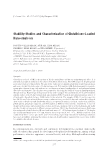
J. Cosmet. Sci., 69, 257–267 ( July/August 2018) 257 Stability Studies and Characterization of Glutathione-Loaded Nanoemulsion NAVEED ULLAH KHAN, ATIF ALI, HIRA KHAN, ZAHEER ULLAH KHAN, and ZIA AHMED, Department of Pharmaceutics, College of Pharmaceutical Sciences, Soochow University, Suzhou 215123, P. R. China (N.U.K.), Department of Pharmacy, COMSATS University Islamabad, Abbottabad Campus, Abbottabad 22060, Pakistan (A.A., Z.U.K.), Department of Pharmaceutical Sciences, Abbottabad University of Science and Technology, Havelian, Abbottabad 22500, Pakistan (H.K., Z.A.) Accepted for publication July 6, 2018. Synopsis Glutathione reduced (GSH) is the mother of all the antioxidants and has an antimelanogenic effect. It is extremely vulnerable to oxidation in the solution form which limits its use. The GSH in nano-oil droplets present a potential solution to this problem. The aim of this study was to formulate glutathione-loaded nanoemulsion and assess its stability studies over a 90-day testing period. To formulate GSH-loaded nanoemulsion pseudo- ternary phase diagram, it was built with various concentrations of water, liquid paraffi n oil, and surfactant mixture (Tween 80 and Span 80). The oily phase was prepared by dissolving the GSH (450 mg) in liquid paraffi n oil through stirring. High-energy homogenization was used to prepare the nanoemulsion. From preformulation stability studies of the 28-day testing period, nanoemulsion (NE-19) with oil and surfactant mixture ratio (1:1) of hydrophilic lipophilic balance (HLB) value 10 was selected. The samples of NE-19 and its respective base (B-19) were kept at four different storage conditions for a period of 90 days and evaluated for physical characteristics, droplet size and distribution analysis, zeta potential analysis, electrical conductivity, mobility, polydispersity, pH, phase separation, and fl ow analysis at different time intervals. Glutathione in nano-oil droplets with nonionic surfactants produced oil-in-water nanoemulsions that were thermodynamically stable over the 90-day testing period at different storage conditions. NE-19 was formulated having non-Newtonian fl ow and pseudo-plastic behavior. pH was found in the range of 5–6. Polydispersity was less than 0.3. The droplet size of fresh nanoemulsion was 96.05 nm, whereas the zeta potential was -37.1. Mobility and electrical conductivity were -2.726 μm cm/Vs and 0.0141 mS/cm, respectively. Glutathione-loaded nanoemulsions have excellent stability, promising the solution in nano-oil droplets and are suggested for in-vivo release studies for oxidative skin related diseases. INTRODUCTION In contemporary eras, extensive and continuous development in consumer claim in the fi eld of cosmetics has spurred the development of sophisticated formulations, aiming at high performance, attractive appearance, sensorial benefi t, and safety. Although with increasing Address all correspondence to Atif Ali at ajmaline2000@gmail.com or atifali@ciit.net.pk.
Purchased for the exclusive use of nofirst nolast (unknown)
From: SCC Media Library & Resource Center (library.scconline.org)