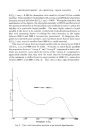
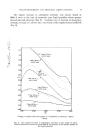
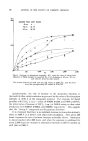
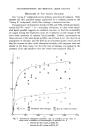
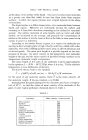
SMELL--THE PHYSICAL SENSE 51 although the level of the stimulus is not altered. To overcome the effect of adaptation, some receptors move so as to enlarge their usefulness thus, the eye has a constant motion with a frequency of about 0-1 second to enable it to be more precise and less adapted. All sense organs respond to stimuli approximately according to the Weber law, which states that the increase of stimulus required to produce a perceptible increase in sensation is always the same fraction of the sensation regardless of its level. Fechner expressed this mathematically--i.e., that the perception of sensation varies as the natural logarithm of the stimulus R ---- alog,S. This law is true only in the middle range of intensity and does not hold for very weak or very strong stimuli. For the sense of touch the fractional increment is about 1/10 to 1/40, depending on the part of the body concerned--for hearing 1/9 to 1/20, and for vision about 1/160. (b) The Visual Sense. A part of the light which impinges on the retina is absorbed by its photo-receptors, of which there are two types: rods and cones. Rods are elongated cylinders like fine fibres cones are shorter, much thicker, conical structures. Their inner parts are connected to the optic nerve via intermediate cell connections their outer parts are sensitive to light. The rods contain a pigment known as visual purple, whose absorption spectrum is similar to the sensitivity of the rods to light. It is possible, but not proved conclusively, that the cones have three different pigments, whose maximum absorption are in the blue, green and red respectively. The cones are grouped principally in the centre of the retina, are sensitive to light of relatively high intensities (about 10 -• candles/square foot and upwards), and in a small number of instances a single cone is connected to a single nerve fibre. Rods are grouped around the cones, thus occupying the peri- phery of the retina, are sensitive to light of low intensity (below 10 -4 candles/ square foot), and hundreds---even thousands---of rods are sometimes con- nected to one nerve fibre. However, there is no sharp line of demarcation in the retina between the areas of the rods and cones, cones existing sur- rounded by rods cones and rods can even be joined to the same nerve fibre. In the human retina there are around 110/125 x 106 rods and 6.5 x 10 ß cones, between them connected to some 1 x 10⁶ nerve fibres of the optic nerve. When light falls on the rods, the visual purple is bleached, and subsequent physico-chemical reactions stimulate the nerve endings of the rod cells and,. eventually, the fibres of the optic nerve. Around 90 per cent of the light is transmitted through the rods and is absorbed in the black pigments behind the retina, possibly giving rise to reactions renewing the bleached visual purple. The amount of visual purple bleached controls the intensity of the stimulation, and it has been found that

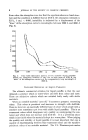
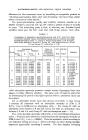
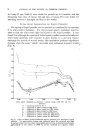
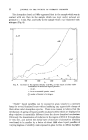
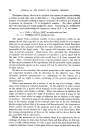
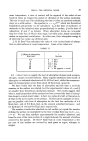
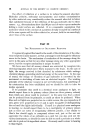
JOURNAL OF THE SOCIETY OF COSMET1C CHEMISTS 5-14 quanta of light is the intensity threshold for the rods. Light of any particular wave length affects rods only in proportion to its intensity and to the degree to which they absorb light of that wave length. There is thus no qualitative response in a manner specific to the wave length, and rods-- being all of one sort---cannot give rise to the sensation o! colour. The essential receptor function is the absorption by a pigment of light quanta with consequent chemical change, resulting in transmission of an mpulse along the optic nerve. (c) The Auditory Sense. The ear consists of the external ear, the middle ear and the inner ear. The function of the first is to collect the sound that of the second, bounded externally by the drum of the ear and containing a bone lever mechanism, is to magnify the sound, this magnification amount- ing to about ten times after allowing for loss of energy to the magnifying lever system. The inner ear is the receptor mechanism of the auditory nerve endings, and this is our immediate interest. It consists of two structures--the "vestibule," concerned with maintenance of equilibrium, and the "cochlea," which is a tube filled with liquid, the "endolymph," 20-30 mm. long, wound spirally around a cone of bone from which a spiral lamina of bone extends about two-thirds across the tube. From the outer edge of this lamina, two membranes extend to the walls of the tube, thus forming three ducts through- out its length. These membranes differ in structure: the basal, called the "basilar membrane," has attached to it the "organ of Corti." The organ of Corti consists of a double row of stiff cells, the inner and outer rods of Corti, which are surrounded on the inner side by a single row, and on the outer by three rows, of hair cells. The fibres of the auditory nerve end in aborisa- tions among these two sets of hair cells. Between the hair cells are the cells of Deiters, whose peripheral processes join together to form a membrane (membrana reticularis) over the hair cells through which the hairs protrude. Resting on top of the membrana reticularis is a membrane (membrana tectoria) projecting from the upper edge of the spiral lamina. In man there are about 24,000 hair fibres, ranging in length from 64 to 128 t• at the base of the cochlea, and from 352 to 480 t• at the apex. There are some 80,000 nerve fibres serving the organ of Corti. A positive pressure sound wave on the drum results in movement of the endolymph in the cochlea, which causes Reissner's membrane to move downwards consequently the basilar membrane is forced downwards and the hair cells are drawn further away from the membrana tectoria. Similarly, a negative pressure wave draws the hair cells closer to the membrana tectoria, which possibly has a damping effect on their movement. There have been many theories of hearing, most of the very considerable body of evidence supporting Helmholtz's theory of resonance. This is simply that the different hair fibres of the basilar membrane each vibrate
Purchased for the exclusive use of nofirst nolast (unknown)
From: SCC Media Library & Resource Center (library.scconline.org)