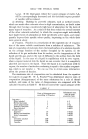
SMELL--THE PHYSICAL SENSE 61 (e) Smell in Animals. Animals vary in the sensitiveness of their response to odorants for instance, the rabbit's olfactory sense is thought to be more sensitive than that of man. The rabbit has a larger olfactory area than man, and each vesicle of the rabbit has about twice the number of hairs. Thus, assuming that the density of the vesicles in unit area to be the same as in man, the rabbit will have a much greater adsorbing surface than man, and would be expected to have a more sensitive sense of smell. (f) (i) Molecular Structure of Odorants. Adsorption varies very con- siderably from point to point over a surface: we have seen that De Boer finds that the first few molecules of gas adsorbed on graphite have about twice the heat of adsorption of the subsequent molecules, showing that adsorption takes place at a few active centres much more strongly than on the remainder of the surface. Hair fibres are constructed from 18 amino acids arranged in various proportions and combinations. It is probable that the hairs attached to a common vesicle have a similar molecular con- struction, and that there is a systematic change in hair structure from vesicle to vesicle, so that various areas of the olfactory organ will respond efficiently to varying odorants. This is supported by the evidence of Adrian TM, who has found that there are parts of the olfactory area where response to a given stimulant is greater than that of the rest of the olfactory area. We have seen that the surface varies and that parts of it will have a greater attraction--i.e., heat of adsorption--for particular molecules than for others. The perception of the type of odour will depend on the part of the brain receiving the message from the olfactory receptors, which in turn will depend on the particular vesicles stimulated. Therefore we would expect stereoisomers to differ in odour, particularly if the active atoms of the mole- cule are spatially shielded by inactive atoms in only one of the isomers. Since the extent to which a molecule will be adsorbed on a surface depends on both its own entire molecular structure and on that of the surface, the members of a homologous series will differ in odour, and--as their vapour pressure drops as the series is ascended--they will also alter in type of odour, the more volatile (high vapour pressure) being rapidly perceived and not persistent, whilst the less volatile will be more slowly perceived and more persistent on an equi-molar basis. (f) (ii) Molecular Structure of Odorants. As a homologous series is ascended, the saturated vapour pressure decreases and thus at a given low pressure the proportion of the surface covered unimolecularly is increased and the vapour produces a stronger smell. During the ascent of such a series the speed of the molecules decreases, consequently the rate at which they diffuse to the olfactory surface also decreases, until a point is reached when these effects outweigh the benefits of the falling saturated vapour pressure. Thus, a series will first increase its intensity and then decrease it as it is ascended.

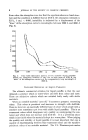
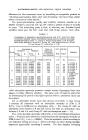
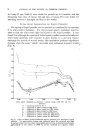
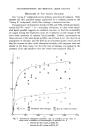
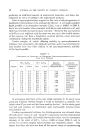
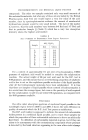
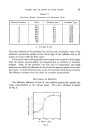
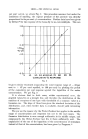
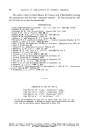
62 JOURNAL OF THE SOCIETY OF COSMETIC CHEMISTS (g) Odour Analysis. Provided that the stimulating strengths o[ two odours are approximately equal when a mixture of them is smelled, and that the composition of the vapour is constant, a blend is first perceived, followed by identification of each individual odour. The order in which they are identified depends on the speed of adaptation of the olfactory area to each, and to the mental attention given to their recognition. If one odour is moderately stronger than the other, the recognition of the blend is followed by that of the stronger, and lastly by that of the weaker as adaptation reduces the response to the stronger more rapidly than that to the weaker (this implies that speed of adaptation is a function of the intensity of stimulus). If the olfactory receptors were not differentiated, we would expect their adaptation to be to the total odour, and the perception to be unaltered in quality but reduced in intensity with time. That the bouquet of the odour changes with time points to receptor differences with respect to quality of perception, but not necessarily to speed of adaptation. (h) (i) Intensity of Perception. From analogy with the Weber-Fechner law applicable to the case of the sensation responding to heat, pressure, hearing, etc., the intensity of perception of an odorant would be expected to be a log function of the intensity of the stimulant. In the case of smell, the stimulant is the energy transferred by adsorbed molecules to the surface. For any one gas it is proportional to the number of molecules of the odorant adsorbed on the receptor area in unit time, which we have seen is directly proportional to the vapour pressure and inversely proportional to the mole- cular weight and the temperature. In our particular case, because heat of adsorption, molecular weight and temperature are constant, the stimulating intensity for any given substance is therefore proportional to the vapour pressure of the substance. In Part II we saw that the response of a nerve to increasing stimulation is by no means uniform, for, as the stimulus increases it evokes responses in increasing numbers of single fibres as it passes their stimulation threshold. We would expect the ease of stimulation of any one specific type of receptor to vary amongst these types in a random distribution and, due to complete lack of information concerning this distribution, our best assumption concerning it is that it is a normal or Gaussian distribution. In that event, any data regarding the intensity of response to odour stimulation should give a straight line when the probit of the cumulative per cent response is graphed against a function of the stimulus (Middleton•8). Data for man of the intensity of perception of anethole in solution in white oil is given by Hainer et al •4 Fig. 5, and the experimental values can be extracted from this figure. When the probit of the cumulative per cent intensity, calculated after classifying the response from 100 per cent anethole as 100 per cent response, is plotted against the logarithm of the concentration
Purchased for the exclusive use of nofirst nolast (unknown)
From: SCC Media Library & Resource Center (library.scconline.org)