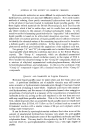
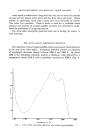
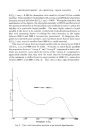
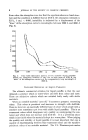
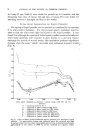
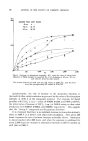
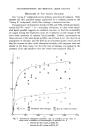
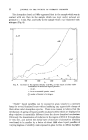
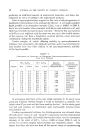
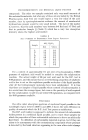
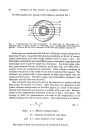
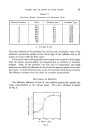
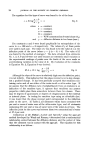
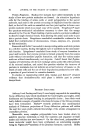
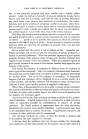
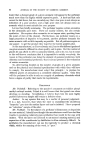
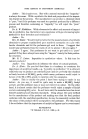
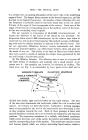
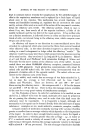
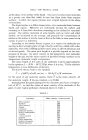
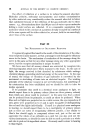
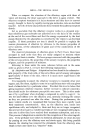
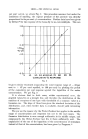
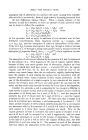
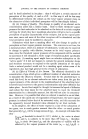
SMELL--THE PHYSICAL SENSE 63 per cent vol/vol, we obtain Fig. 2. This procedure assumes that under the conditions of smelling, the vapour pressure of the anethole was directly proportional to its per cent v/v concentration. Further data have been given by Dethier •' for the response of the house-fly to iso-valeraldehyde. This can / , / / , / / I.( LOG K O/o v/v -3.( 5 IO 20 30 ,40 50 60 70 80 90 05 CUMULATIVE ø/o RESPONSE Fig. 2 be given similar treatment (expanding the total response range of -- 23 per cent to + 67 per cent repelled, to 100 per cent) by plotting the probit of the cumulative per cent response against the logarithm of the molar concentration. We get Fig. 3. It is obvious that in both cases, within experimental error, the graphed values lie on a straight line, and therefore the distribution of the numbers of receptors of one type with thresholds of a common value is a Gaussian one. The slope of these lines gives the standard deviation of the distribution, and, when further data is available, should yield interesting information. We now see the reason why the Weber-Fechner law applies to the middle range of concentrations and responses but not to the end ranges. The Gaussian distribution is near enough arithmetic in its middle ranges, and consequently the Weber-Fechner law fits it there sufficiently well. The explanation of the use of the logarithm of the concentration of stimulant, instead of that of the concentration, has been given by Ferguson. •,

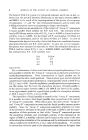
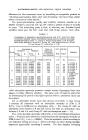
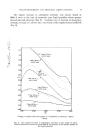
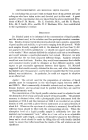
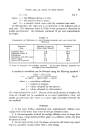
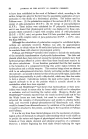
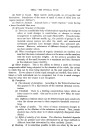
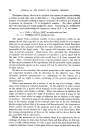
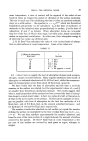
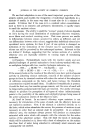
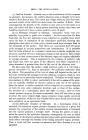
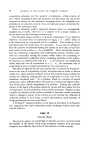
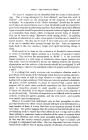
64 JOURNAL OF THE SOCIETY OF COSMETIC CHEMISTS BxiO- 5 4x 3xl! MOLAR C...ON C'N 0x 4XlO 2 5 IO 2.0 30 405060 70 80 go CUMULATIVE ø/o RESPONSE Fig. 3 Ferguson draws attention to the relation between the partition coefficient of a substance between two phases and its partial free molar energies in the two phases, and points out that in toxicity studies, etc., in a homologous series the linear relation between the logarithm of the various types of distribution coefficients and the number of carbon atoms indicates that the constant addition of partial molar free energy at each step is the controlling factor. For vapours •'e have :-- f•/7o q- R• 1øge P/Ps where Fo,F are the partial free molar energies of a reference state and the state under con- sideration, and •b/•b s is a near enough estimation of the activity of the vapour. Ferguson finds that the ratio •b/• s is between 0.01 and 0 07 for a wide variety of vapours toxic to mice, and has also a small range, although different, of values for toxicity for insects. We have seen that the ratio log •/•bs is the most suitable measure of the applied stimulus in relation to the response of the olfactory organs to increases in vapour concentrations. Therefore, it would appear that stimuli which result from the distribution of two vapours each between two phases.
Purchased for the exclusive use of nofirst nolast (unknown)
From: SCC Media Library & Resource Center (library.scconline.org)