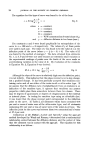
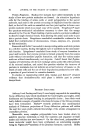
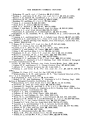
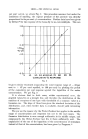
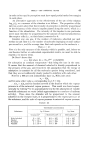
SMELL--THE PHYSICAL SENSE on the shape of the surface of the liquid ß thus con vex surfaces lose molecules at a greater rate than flat, which in turn lose them faster than concave surfaces ß in effect, the vapour pressure near a liquid depends on the shape of its surface. The liquid surface is a diffuse demarcation, a few molecules thick, between liquid and vapour. Molecules are continually leaving the surface and returning to it from both directions, remaining on the surface for very short periods. The surface molecules of some liquids, such as water and ethyl alcohol, are orientated on the average, and generally the concentration of solutes on the surface is not the same as that in the bulk in some cases it is in excess, in some in a deficiency. According to the kinetic theory of gases, in a vapour the molecules are moving in short straight paths of high velocity until they collide with other molecules, when both colliding particles move away in altered directions and at altered speeds. The mean path length of a particle depends on the tem- perature of the gas the mean velocity on the temperature and molecular weight of the gas, and the mean number of particles hitting a surface on its temperature, molecular weight and pressure. The mean length of free path of the molecules is given approximately by the equation L -- (2'78 , 10-5)T/273p, where L is in c•n., T is the absolute temperature, p is in millimetres of mercury. The kinetic theory leads to the equation -- U-= •/(8Rr)/•/(rrM) cm./sec. -- 145'55/T/•/M metres/sec. -- for the speed of any molecular species, where U is the mean velocity, M the molecular weight, R the gas constant, ,r is 3'141•. Assuming that the gases passing over the olfactory area have a tempera- ture of 32 ø C., we find the values of mean velocity of the molecules of the gases of some typical perfumery chemicals shown in Table I. TABLE I Substance Mean velocity, metres/second. Ethyl alcohol Pyridine .. Ethyl acetate Phenol .. Coumarin Cinnamic alc•)•ol Methyl anthranilate Vanillin •e-decyl alcol•( 1 Eugenol .. Ethyl cinnamate Isobutyl benzoate Benzyl benzoate 374 285 269 262 210 208 207 207 202 199 191 191 175

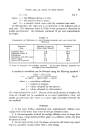
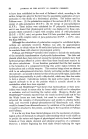
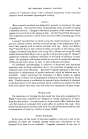
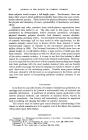
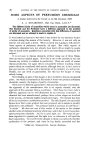
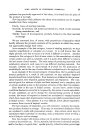
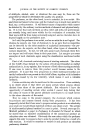
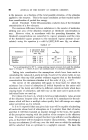
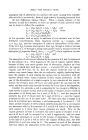
56 JOURNAL OF THE SOCIETY OF COSMETIC CHEMISTS The kinetic theory allows us to cMculate the number of molecules striking a surface in unit time, and we find that n: Np/v'(2•rMRT ), where n is the number of molecules striking a square centimetre of a surface per second, p is pressure in dynes/cm. •', N is Avogadro's number: the other symbols have the meanings previously assigned to them. Converting p to millimetres of mercury and substituting the numerical values of N, rr, R, we obtain n = (3'52 x 10•.•)p/x,/(MT ) in molecules/cm. 2/sec. or n = O'O583pV'(M/T) grams/cm.2/sec. The vapour from a perfume consists of many substances which we can assume do not react together, as any molecules which would do so in vapour form can be presumed to have done so in the liquid from which they have evaporated, since physical conditions for such reactions are so much more favourable in the liquid state. The vapour will therefore obey Dalton's "law of partial pressures," which states that--provided the temperature is constant--the pressure of a mixture of yapours in a given space will be the sum of the pressures which each would have if it alone occupied the space. Thus, a perfume should have a vapour pressure equal to the sum of all the vapour pressures of the ingredients, and the saturated vapour pressure of each molecular species in the vapour will not be altered by the presence of other species. We have so far considered the intrinsic properties of the vapour and have not concerned ourselves with its detection by the olfactory area. This obviously involves condensation--i.e., adsorption--of the vapour on a surface, and we ought to know something of the general properties of adsorbed gases. When a gas molecule hits a surface, it can do one of two things: either stay on the surface or rebound elastically. In the majority of cases it stays on the surface for a period which depends on the nature of the particular piece of surface with which it collides. When the molecule is reflected, the angie of reflection equals the angie of incidence, but when it stays on the surface for a short while the angie of reflection has no relation to the angle of incidence. The time it stays on the surface is determined by many factors, such as the kinetic energy of the molecule (this will be its own individual kinetic energy and not that of the mean of all the molecules), the temperature of the surface, the nature of the molecule and of the surface, etc. If the molecules stay on the surface for a time {even for a very short time), then the average concentration of them on the surface will be above that in the gas, and there will be adsorption. Whilst the molecules are on the surface, there is an opportunity for an exchange of energy to take place between them and the surface (in this way a hot, or cold, surface warms, or cools, a gas), and it has been found that for complete exchange of heat to take place between them, so that both have the
Purchased for the exclusive use of nofirst nolast (unknown)
From: SCC Media Library & Resource Center (library.scconline.org)