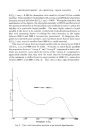
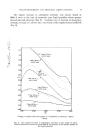
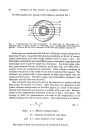
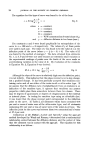
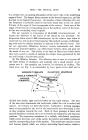
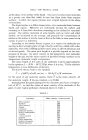
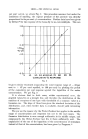
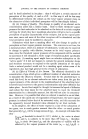
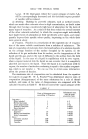
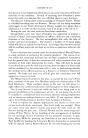
SMELL--THE PHYSICAL SENSE 53 to a certain note, so causing stimulation of the nerve cells of the underlying organ of Corti. The largest fibres resonate to the lowest frequencies, and the shortest to the highest frequencies ß the number of hairs vibrating with any one frequency is probably small (it has been found that in the cat about 2.5 mm. of the organ of Corti corresponds to the octave). Each area of the organ ol Corti has its corresponding area in the auditory centre of the brain, in this way resembling visual response. The ear responds to frequencies of 40-40,000 vibrations/second. It locates the direction of the source of the sound by two processes' for frequencies below about 1,000 vibrations/sec. by the relative time taken to reach each ear, but at about this frequency this method becomes of diminish- ing value and the relative intensity at each ear is the effective factor. The ear can appreciate differences between various instruments and, when several are sounded together, can differentiate between them and pick out the sound of any one. This ability is the basis of Ohm's law (which states that every sound is capable of analysis into simple tones appreciated by the ear and having a characteristic pitch). (d) The Olfactory Receptor. The olfactory area in man is a by-pass off the main stream of inhalation, and normally only a small amount of air passes over it' this quantity can, however, be increased by sniffing. The nasal area--see Fig. 1--is surrounded by bony parts of the skull and is -•UI•ERIOR TURBINATE OLFACTORY MEM3RANE Fig. 1 ßvided into similar right and left halves by the nasal septurn. The base of the area runs do•wards and backwards, whilst the roof is arched and na•ow. In between are three flat bones, "turbinates," for•ng passages more or less parallel to the roof of the n•al cavity and decreasing in size as they pro•ess towards the roof. Each of these passages is lined with mucous membrane of which there are t•vo •nds: the respiratory and olfacto• portions. The respiratory membrane is a red•sh, well-defined membrane which covers the lower part of the cavity, the •ferior and •ddle turbinates and the corresponding areas of the septurn. This membrane contains serous and mucous glands which are always generating liquid matter, which is

JOURNAL OF THE SOCIETY OF COSMETIC CHEMISTS kept in constant motion towards the nasopharynx by the plentiful supply of cilia in the respiratory membrane and is replaced by a fresh layer of liquid about once in ten minutes. This mechanism has several functions' it warms and humidifies incoming air, regulates the air currents in the nasal cavity, acts as a filter and, as a result of the action of the enzymes it contains, keeps the olfactory area sterile. The olfactory portion, which in man is about 5 sq. cm., lines nearly all of the superior turbinate, a little of the middle turbinate and the top third of the nasal septum. It has neither cilia nor a distinct membrane, is yellowish brown in colour and has three principal kinds of cells, our interest being in the olfactory ones, which comprise some 70 per cent of the total. An olfactory cell tapers in one direction to a non-medulated nerve fibre attached to a glomeruli which also receives the fibres from several hundred other olfactory cells in the other direction it tapers to a short nerve fibre, ending in a small enlargement or bulge called the olfactory "vesicle." The olfactory vesicle has many short hairs which project into the mucous covering of the nasal cavity ß they are about 1-2/x long and 0' 1 t• in diameter. Hainer et al.• and Mozell and Pfaffman 6 both summarise findings of Allison and Warwick 7 for the nerve system of the olfactory area of the rabbit. In each nostril there are about 50,000,000 olfactory receptors, connected between them to 1,900 glomeruli. Each glomerulus communicates with about 24 mitral cells and 68 tufted cells, the latter being interconnected with the glomeruli of similar cells of the opposite nostril. The mitral cells are con- nected to the olfactory area o! the brain. In the rabbit, each vesicle has an average of ten hairs attached to it, but in man the average is 5-6 (Warwick and Le Gros ClarkS Allison and Warwick7). There are between 10 and 100 x 106 nerve fibres serving the olfactory nerve ß this compares with 1 x 10⁶ for the human eye and 0'08 x 106 for the ear. There is thus the message system available in the nose for a very great variety of simultaneous messages. (e) The Properties of Gases. In order for a substance to be smelled, as was shown by J. Aitken • to be true for musk, molecules of it must be present in the air passing the olfactory area, and in order that this shall occur the substance must be vaporisable. It is frequently a liquid, although not necessarily so, for vapour can be formed directly from the solid state of many substances ' examples are ice, musk ambrette, coumarin, camphor, vanillin. A liquid consists of molecules constantly moving with varying velocities greater or smaller than an average velocity which depends on the temperature of the liquid. In order to have enough kinetic energy to leave the liquid a molecule must have a velocity greater than the average' e.g., in water at 0 ø C. a molecule needs a velocity of around 1'45 x 10 • cm. per second in order to leave the liquid, whereas the average molecular velocity in the liquid will be about 6 x 104 cm. per second. The rate of escape of molecules depends
Purchased for the exclusive use of nofirst nolast (unknown)
From: SCC Media Library & Resource Center (library.scconline.org)