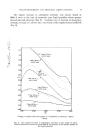
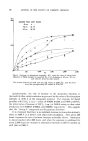
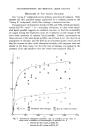
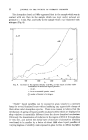
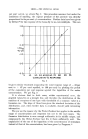
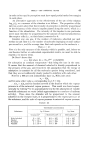
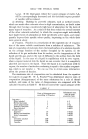
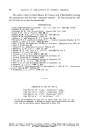
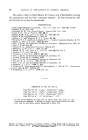
SMELL--THE PHYSICAL SENSE 57 same temperature, a time of contact will be required of the order of one hundred times (or longer) the period of vibration of .the surface molecules. This can be made use of in calculating the time (,) that an adsorbed molecule stays on a solid surface: the equation is ß: %.eOlRr which has theoretical foundations and permits ß to be calculated. ('o is the time of oscillation of molecules in the adsorbed state perpendicularly to surface, Q is the heat of adsorption, R and T as before). When adsorption forces are non-polar they are of the Van de Waal's force type, but when polar, dipole interaction makes an important contribution. In either case, their adsorption energy is of relatively low order, say 20 Kcal./mol. J. H. de Boer xø has calculated the value of ß for various heats of adsorp- tion on solid surfaces at room temperature. Some of his values are: TABLE II Q (Heat of Adsorption) Kcal./tool. 3.5 4 10 15 20 25 Seconds 4 X I0 -n 1 x 10 -•ø 3-2 x 10 -s 1.8 x 10 -2 1.0 x 10 2 6 X 10 5 (approx. a week) 3'5 --4 Kcal./mol. is roughly the heat of adsorption of gases such as argon, nitrogen, oxygen on solid surfaces. Many organic substances have heats of adsorption on technical adsorbents of 10-15 Kcal./mol., whilst the commence- ment of chemisorption occurs from about 20 Kcal./mol. upwards. We have found that the heat of adsorption and the time a molecule remains on the surface are related, but the experimental values of r and Q are smaller than theoretical calculations indicate. The results suggest that when a small proportion of the surface has been covered the heat of adsorp- tion drops to a much lower value in fact, to a value of a half, or thereabouts, of that on the active spots on the surface. De Boer gives examples of nitro- gen on graphite with heat of adsorption for the first few molecules of 4.4 Kcal./mol., and of 2.3 Kcal./mol. as the amount adsorbed increases and for hydrogen of 1.8 and 0.9 Kcal./mol. respectively. The number oI molecules adsorbed on unit surface (,) equals the number striking the surface (n) multiplied by the time (r) that they stay on it --i.e., (r -- nr. We can thus calculate approximately the number adsorbed, and from the area of the cross section of a single molecule the amount of surface covered by the species. De Boer • finds that at room temperature a few per cent of any surface are covered by such gases as argon, nitrogen or oxygen.

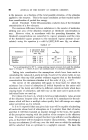
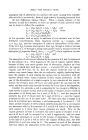
JOURNAL OF THE SOCIETY OF COSMETIC CHEMISTS The effect of reflection at a surface is to reduce the amount adsorbed. Molecular polarity, molecular non-symmetry and surface contamination by other materials very considerably reduce the amount adsorbed to below that calculated because of the reflection of the gas molecules due to these causes: e.g., determinations show that 96 per cent of water vapour molecules hitting a water surface are reflected. It is a reasonable assumption that molecules which strike a surface at a position already occupied by a molecule of the same species will be either reflected or, at most, held for an exceedingly short time at the surface. PART III THE MECHANISM OF OLFACTORY ]½,ESPONSE It is generally agreed that smell is the result of the stimulation of the olfac- tory receptors in some manner, so that a message is sent through the olfactory nerve to the brain. The mechanism of conduction of the message along the nerve is the same as that for any other message along any other appropriate nerve, but the receptor mechanism is unique to smell. We have seen that all sensory stimuli are converted by receptors into electrical impulses which nerve fibres transhilt to the brain. In the case of light, the energy received is first absorbed by substances which undergo chemical change, generating electrical energy at the same time. In the case of sound, the energy of vibration of gas molecules is converted by the movement or stretching of hairs into an electrical impulse. The working principle of the olfactory receptor is not yet fully known, but something of its construction has been established and we should be able to infer its modus operandi. If we postulate that smell is a chemical sense analogous to light, we should expect there to be primary odours (there are three primary colours) from which any odour could be produced: in the same way that a colour can be produced from its primaries, so could an odour be produced. When blue and red lights are projected on to a white screen, the eye responds as if only green were projected on to it and is quite incapable of distinguishing the red and blue lights individually. If smell is a physical sense analogous to hearing, we should expect there to be a multiplicity of primary odours just as there are notes of recognisably different pitches, a law similar to Ohm's law should apply to compound odours and, just as the ear can appreciate the whole of an orchestra as a unit but can also pick out the various instruments, so should the nose be able to smell a perfume as a whole and also to pick out its ingredient odours. Obviously smell is closer to hearing in this respect.
Purchased for the exclusive use of nofirst nolast (unknown)
From: SCC Media Library & Resource Center (library.scconline.org)