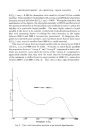
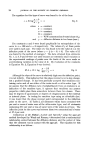
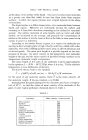
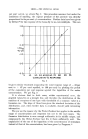
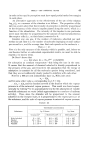
SMELL--THE PHYSICAL SENSE analogous case of adsorption on a surface with spots varying from consider- able activity to no activity, those of high activity becoming saturated first. (h) (iii) Differences between Odours. When a simple mixture of two odorants (a and b) is smelled, we have an amount of each adsorbed which can be shown to follow the equations: •---- (•o)• baP•,/(1 q-' b•p• q- bbpb) and ab = (ao) • b•p•/(1 + b•p•) q- b•pb) where b,,: N•'a/(ao),,•/(2rrM,,RT ) b• = N,b/(•o)•/(2•rM•RT ) At low pressures, such as apply to mixtures of two odorants near to their threshold concentrations, these equations become a,: (ao)•b•p•, and %---- (ao) • bbp b, and the adsorption of either is independent of the other. If the term b•p• becomes much greater than b•p• through a relative increase in pressure of a, or through b• being much greater than b• because its heat of adsorption Q• is greater than Q• (for ,•: (,o)•eO/Rr), these equations become a• •- (ao) • bap•/(1 q- b•p•) and = bbp/(1 + The adsorption of a is now not affected by the presence of b, but b is depressed by the presence of a. (This happens in the case of organic yapours which, because of their very much greater heat of adsorption, displace air from surfaces to which they both have access. , is around 10-* secs. for organic yapours and 10 TM secs. for air, thus the organic molecules stay on the surface very much longer than the air molecules, rapidly displacing them, since the number of each striking the surface has no connection with the number already there, being a function of their vapour pressures.) In the case of the stimulation of a single receptor by two odorants at low concen- tration, the receptor hairs will have a Q value greater for one than for the other, and this could easily increase its value for b over that of its competitor. Consider two odorants a and b, competing for two receptors differing to some extent in nature so that most active spots of receptor A have a heat of adsorption of 15 Kcals./mol. for a and of 10 for b and the receptor B similarly has Q of 15 Kcals./mol. for b and of 10 for a and the vapour pressures of each are of the same order. We have seen that a change in Q from 10 to 15 Kcal./mol. increases ,, and consequently b, by about 5 x 10 4 times, so that receptor A will be almost entirely stimulated by a, its response not interfered with by the presence of b, and B will behave in like manner with respect to b when their vapour pressures are small. Now, as the vapour pressure of both is increased, the active spots of receptor A for a and of B for b •vill be occupied by a and b respectively, and the more generalised structures of A and B will become of importance. For these, in the case of A, Q for a will be below the original 15 Kcal./mol., but little altered for b, and vice versa for B. The presence of each of the odorants will now reduce the adsorption of the other on their respective receptors,

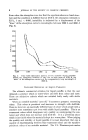
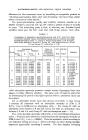
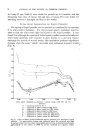
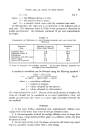
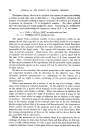
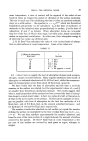
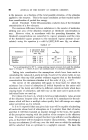
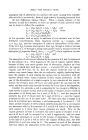
68 JOURNAL OF THE SOCIETY OF COSMETIC CHEMISTS and be itself adsorbed in its place: thus b will give a certain amount of perception of the quality A, and a of B: in this way it will be less easy to differentiate between the odours as the total vapour pressure rises, as the charactm, of their individual perceptors will be less sharply defined. (h) (iv) Change of Quality. The change in quality of an odorant as its concentration alters has a similar basis. Close to their threshold vapour pressure the first molecules to be adsorbed on the hairs of a certain receptor cell type for which they have maximum adsorption will give rise to a specific perception of quality characteristic of the receptor, but as the vapour pres- sure rises, more and more of the other receptors will be stimulated and the total perception must be modified in character. Substances which have a masking effect will also change in quality of perception as their vapour pressure increases. The converse is not true, for a natural product, which is a mixture of substances, would also be expected to change in quality with dilution, because as its total vapour pressure rises, since the threshold vapour pressures of its components will be reached in succession it will stimulate a wider range of receptors at. their specifically active spots. (A masking agent might have no selective adsorption on the "active spots" if it did not happen to contain the general molecular shape and structure necessary to respond to the specific attraction of the spot.) Such a natural product would not be a masking agent unless some of its ingredients also had high general levels of heat of adsorption. (h) (v) Effect of Velocity of Air Stream. The olfactory threshold is the concentration of gas which gives a sufficient number of adsorbed molecules to stimulate the olfactory receptor. It takes time for the adsorbed layer to reach this level, for as odorant molecules are taken away from the gas the vapour pressure of the odorant in the neighbourhood of the adsorbing layer is lowered and recovers to the general concentration only after diffusion has taken place. An air blast might be thought to increase th• speed of diffusion and reduce the time taken for the adsorbed layer to reach the threshold concentration by a detectable amount, but this will not alter its concentra- tion. However, it is possible that when an odorant is smelled in an air blast, as a result of the raised rate of evaporation of liquid water, the water vapour pressure is reduced below that of its saturated value, and this accounts for the apparently lowered threshold value obtained by air blast methods. In its simplest, the effect of water vapour is a case of the adsorption of two gases, one in much greater amount than the other--so much greater that generally bwp w will be in large excess of b•p a. An example will make this clear: Pv•iz•i• at threshold is about 5 x 10-•*, whilst p• for water is about 35.6, and by is unlikely to be more than 10 • times bw: therefore b•p• is about 10 • times b•p• and the adsorption of vanillin will be affected by the vapour pressure of the water (% -- (%)• b•pv/(1 +
Purchased for the exclusive use of nofirst nolast (unknown)
From: SCC Media Library & Resource Center (library.scconline.org)