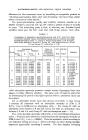
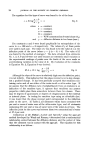
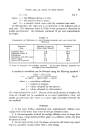
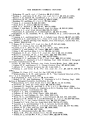
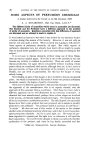
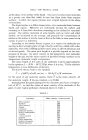
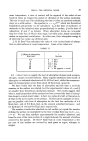
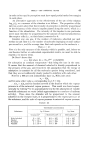
SMELL----THE PHYSICAL SENSE 69 bwpw) ). If the blast gases reduce the vapour pressure of water, b•,p• will be correspondingly decreased and the threshold vapour pressure of vanillin will be reduced. (i) Masking. Masking by powerful odorants, such as methyl ionones, which can mask other odorants when in high concentration, no doubt arises through their having a moderately high heat of adsorption for the hairs of many types of receptors. As a result of this they reduce the overall amount of the other odorants adsorbed, to which the receptors might individually have higher heats of adsorption at their specifically active spots, and conse- quently depress their specific odour quality, impressing on the whole their more general odour. (j) Fixation. Fixation is a retardation of the expected rate of evapora- tion of the more volatile constituents from a solution of substances. The rate of evaporation of molecules from the liquid surface of a solution depends on the average fraction of the surface occupied by its species, on the reflection of its gas molecules from its surface, on the temperatures of the liquid and the gas, and on the rate of diffusion to the surface from the bulk of the liquid. In the case of a liquid in equilibrium with its own vapour, when a vapour molecule hits the liquid we can consider that it is completely adsorbed and stays in the liquid. Since the liquid is in equilibrium with its vapour, the number of molecules condensing is equal to the number evaporat- ing, vhich is our number Jr. We can use this to obtain some information about the process of fixation. The maximum rate of evaporation can be calculated from the equation for n given on page 56. W. A. Poucher a0 has determined relative rates of evaporation (disappearance) of the same substances by a rule of thumb method, and some of his rates of disappearance are compared with the calculated maxima in Table V. He did not control the vapour pressure of the TABLE V Rate of disappearance according to Poucher. Top notes: Ethyl alcohol Methyl butyrate Amyl proprionate Isobutyl benzoate Decyl alcohol Middle Notes: Eugenol Methyl anthranilate Ethyl cinnamate Bases: Cinnamic alcohol Coumarin Vanillin Calculated max. rate oi evap. gram/cm.a/sec. 1 4 4 8 11 16 21 24 lOO lOO lOO 4-2 1.6 0.12 0,0053 0.0051 0 0018 0.0018 0,0015 0 0008 0.0007 0 00008

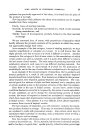
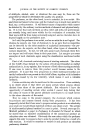
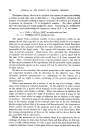
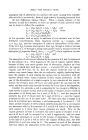
70 JOURNAL OF THE SOCIETY OF COSMETIC CHEMISTS evaporating substance nor the quantity of substance--within a factor of two--whose evaporation time was measured, nor determine the end of the evaporation except by the substance becoming below the threshold con- centration in an unknown amount of air, nor take any steps to determine the purity of the substances used. There is obviously positive regression between these two incompletely founded sets of results. However, it is unlikely to be a simple relation, as can be seen from the following considerations. The saturated vapour pressure at absolute temperature T of a liquid is related to its latent heat of evaporation by log,p s = I3 -- Q/RT, where Q is the latent heat of evaporation and B a constant. This enables Ps to be calculated from the latent heat of evaporation. It can also be calculated from the number of molecules hitting the surface in unit time, as has been done earlier in the article, n = N•,,/V'(2rtMRT ). These calculations assume that the continuous evaporation and condensation process, whereby mole- cules are continually leaving the surface whilst others are condensing in it, goes unhindered by reflection of the condensing molecules at the surface. If a fraction • is reflected, then only n (1 -• •) will condense and equilibrium exists when the rate of evaporation is n (1 -- •): the maximum rate of evaporation is now no longer represented by the equation for n. The effect of reflection can be very considerable, as is shown by determina- tions of the rate of evaporation of polar molecules such as water at known values of p, when as much as 9•3 per cent of the particles of gas striking the surface are reflected, reducing the rate of evaporation to 4 per cent of its maximum calculated rate. • In a perfume, which is a solution of several substances, such a reflection effect will result in a considerable degree of fixa- tion of the more volatile constituents of a perfume. Sharing the available surface of the liquid with another molecular species will also reduce the rate of evaporation, as will orientation of the surface molecules. Fixation is thus a matter of reduction of the surface available to the more volatile molecules and/or a change in nature of the surface so as to increase the reflection of molecules striking it, and, being a surface phenomenon, small amounts of foreign substances can have large effects. J. Pickthall -ø• discusses fixation on the basis of deviations from Raoult's law, suggesting that dipole association and/or hydrogen bonding have sub- stantial influence. P&R• I¾ FUTURE WORK The greatest gaps in our knowledge of olfaction are those concerned with the identify of the odours which cause maximum response from particular receptor$, and with the adsorption of the tnolecules on the receptors.
Purchased for the exclusive use of nofirst nolast (unknown)
From: SCC Media Library & Resource Center (library.scconline.org)