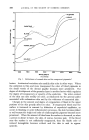
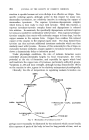
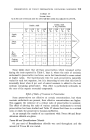
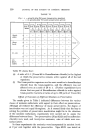
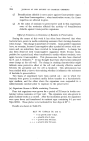
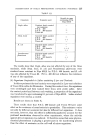
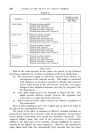
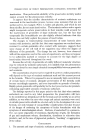
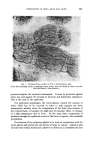
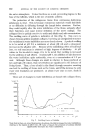
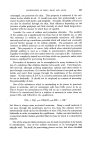
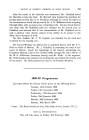
PENETRATION OF SKIN--DEAD AND ALIVE 235 the surface and stay in the surface layers. Leather can be oiled only when it contains free water. The simplest case is when wet leather is coated with oil and evaporation of water is allowed to take place at the other side. It would be simple to suggest that as the water leaves the interfibrillar capillaries--which in leather are much more in evidence than in skin--it draws the oil inwards. To some extent this is true and the viscosity of the oil is a dominant factor. On the other hand, some oils are better than others, but those which are success- ful are characterised by their ability to spread on the surface of water and, further, spread as an attenuated film on the contaminated surface. Because a free water surface is necessary it follows that if the leather, when anointed with oil, is completely saturated with water, no oil will enter the leather. As the water content is lowered, free water surfaces will become available so that the rate of take-up of oil is increased 4 (Fig. 5). But the process is not quite so simple, because if the fully wetted leather is churned in a dilute emulsion of oil-in-water, the whole of the oil can be rapidly taken up by the tanned pelt. This effect depends on the stability of the emulsion in contact with the leather. Stable emulsions, notably those made with non-ionic emulsifiers, are useless--practically no oil is absorbed. 40 tO RATE •, AB$O•"PTIOPl o, COD 011. $0 I I•0 ! .50 200 •0 300 TI I"l E Fig. 5. When the fibre structure of leather is fully saturated with water, oils cannot penetrate. When the water content of leather is less than this, the oil can penetrate but the rate is dependent on the free water-wet surfaces which are available.

236 JOURNAL OF THE SOCIETY OF COSMETIC CHEMISTS Semi-stable ones are required, but even here coarse ones will leave the oil on the surfaces of the skin while extremely fine ones will penetrate too deeply and make the leather flaccid--a property not generally desired. Of course, mechanical squeezing by drumming is resorted to in order to speed the process. In a way, this simulates flexing, and everyone knows that to wet a chamois leather with water is a long job unless the leather is "worked." This particular feature is one of the essential processes of topical application to the living skin. The mere rubbing of oil on a wet surface helps considerably to bring about wetting of the substrate, probably because such ingredients as may be polar can reach the water interface and lead to spreading. There is significant evidence that proteins have oleophilic properties, and an orientated film of oil will be able to cling to a fibre surface if it can be forced into contact and may quite well de-wet the surface of collagen fibres, and even though a detergent be present, some of the oil may be bound. This certainly applies to wool, which cannot be absolutely freed of grease by the ordinary detergents of commerce.* The manufacturer of leather can employ many artifices which would be impossible with the living skin. He can bring the pelt to any pH value he chooses. He can open up the structure by treating the skin with a suspension of calcium hydroxide (pH 12.4) which also disperses and gets rid of most of the interfibrillary proteins. He can treat the limed pelt with tryptic enzymes to clean the collagenous fibrous tissue further. He can treat the skin with acids to bring the proteins to pH values of 4 to 5, where the packing together of the fibres is about minimum. He can subject the skin to some- what severe pressure and agitation to assist penetration. Nothing Like this is available to the cosmetician. On the other hand, it must not be overlooked that the living skin is continuously moving. Although this movement is small, it nevertheless has a profound effect. The fact that the tissues of the skin, except the outer layers of the epidermis, are bathed in a stream of fluid means that substances which do enter the cutis vera will be carried away, utilised or destroyed by the Living organism to its own ends. How far substances can penetrate into the living structure is prescribed by the effectiveness of the epidermis as a barrier. It is beyond argument that a damaged epidermis is a serious matter. The literature covering penetration of living tissues is vast. Even if one excludes such aspects as, for example, the permeability of the cell walls of bacteria or blood corpuscles, that relating to skin is still immense. It is almost impossible to find any hypothesis which can explain the mechanism by which all forms of penetration occur. There are a few facts, however, which are reasonably proven. Firstly, it is true that water-soluble substances, provided that they are
Purchased for the exclusive use of nofirst nolast (unknown)
From: SCC Media Library & Resource Center (library.scconline.org)