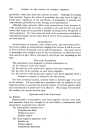
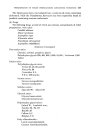
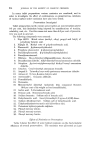
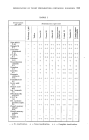
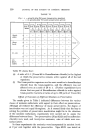
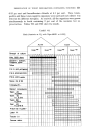
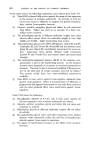
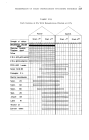
254 JOURNAL OF THE SOCIETY OF COSMETIC CHEMISTS It should be noticed that the same products cause irritation in soaps as in creams, but the degree of irritation varies considerably, and it must also be borne in mind that most of the soap is rinsed off the skin and with it much of the perfume. Essential Oils known to cause discoloration in toilet soaps: The action of light will greatly accelerate this condition, but not all the discoloration is due to the action of essential oils. One must carefully investi- gate the action of the other ingredients and one must ensure that the machinery being used is well coated inside and not showing signs of rust or copper or other traces of soft metal. It can be presumed that most essential oils and gum resins will cause some discoloration in soap, clove oil, for instance, giving a very dark discoloration, whilst others will only turn the soap a creamy colour. Synthetics will not behave very badly except for such products as vanillin, eugenol, heliotropine, indole, quinoline, nitro-musks, neroline, etc. They will not give a deep discoloration, but a certain discoloration will be noticed when a compound is used to perfume soap. It is not possible to produce a white soap without the help of a whitening agent. [Received: 17th February 1958] DISCUSSION MR. F. V. WELLS: In view of the once widespread use of sandalwood oil as a urinary antiseptic and its popularity as a soap perfume, not forgetting also the regular use of the oil and the powdered wood in Hindu ritual and daily life, I am surprised that this oil has been included as an irritant. Will you please tell us whether you consider it a common offender, or a bad offender in this respect. THE LECTURER: Sandalwood oil is an irritant and, although a common offender, is not a bad offender. The irritation caused is slight but is never- theless real and, like many other known irritants, is constantly used in formulations. In soap, most of the offending material is washed off the skin during the rinsing process. It is then followed by rubbing with a towel and any slight irritation is then perhaps unnoticed by the user. MR. J. PICKTHALL: Mr. Botfield has mentioned a number of essential oils which have given rise to irritation. I notice that bergamot was not among these. Has the speaker been able to confirm the much-quoted irritating effects of this particular oil ? If this irritation has been confirmed, do the same remarks apply also to the terpeneless oil ? THE LECTURER: I have noticed irritation from bergamot oil only when used as an eau-de-Cologne and not in soap. The soap is, of course, rinsed off

THE ART OF THE PERFUMER 255 the skin and with it most of the offending aromatics, but in a toilet water, the oil being left on the skin gives rise to a certain amount of irritation, which is very variable. I regret not mentioning this it was certainly an oversight. The terpeneless oil acts in a similar manner, although I consider the effects much milder. • MR. R. T. DOBSON: IS the odour value of a perfume in soap affected when the soap contains titanium dioxide ? TaE LECTURER: The odour of a perfume in soap is affected a little when the addition of titanium dioxide is made. It is difficult to offer a correct explanation, but one can only presume that certain components of a perfume are adsorbed by the titanium dioxide. The differences are very slight and vary from perfume to perfume, and in some instances the difference is for the better and is preferred. MR. F. W. BELLAIRS .' Benzyl alcohol has been mentioned as an irritant, but surely the effect is anaesthetic rather than irritant ? TaE LECTURER: BenZyl alcohol has definite irritant qualities and is sometimes claimed as being a cause of dermatitis. The excessive use of benzyl alcohol in preparations being rubbed into the skin, or inhaled, should be avoided. DR. W. MITCHELL .' When an "optical bleach" is present in a perfumed detergent, does it, because its declared purpose depends on the absorption of incident ultra-violet radiation, have an effect in protecting the perfume from the harmful effects, if any,. of such radiation ? THE LECTURER: I have not studied this action to any extent. On one or two occasions I have had cause to look into this question, each occasion relating to perfume in soap and not detergent, but without any conclusive results. The question is a very interesting one and it is my intention to pursue this matter more fully. MICROCARD EDITIONS OF THE JOURNAL Vols. I to VIII incl. are now available in microcard form. A complete set, a single volume or a single journal may be ordered from Iota Services, Ltd., 38, Farringdon Street, London, E.C.4. The current and future volumes of the Journal will also be available on microcards, in the year following that of publication.
Purchased for the exclusive use of nofirst nolast (unknown)
From: SCC Media Library & Resource Center (library.scconline.org)