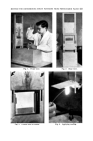
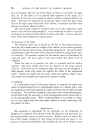
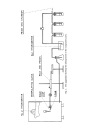
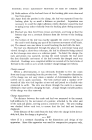
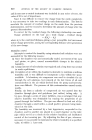
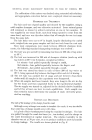
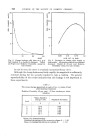
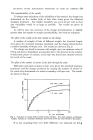
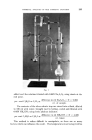
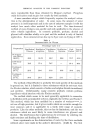
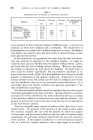
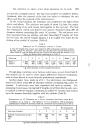
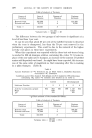
238 JOURNAL OF THE SOCIETY OF COSMETIC CHEMISTS Manipulation of the hair in the apparatus was effected by a polythene sleeve and glove, sealed to the Perspex sheet (Fig. 1). The apparatus is considered under the headings: Charge generation charge detection charge measurement charge removal humidity control. Charge generation A lock of hair of standard weight and length, tied at the root end, was drawn upwards through a fixed number of teeth (six) in an ordinary poly- styrene comb which was clamped horizontally in a Teflon collar to avoid undue leakage to earth. The end of the clamp holding the comb passed through the Perspex wall of the humidity chamber to a rack and pinion device, which moved the comb in a horizontal direction to and from a freely suspended gold leaf. Further insulation against leakage was provided by a second Teflon collar between the clamp, and the rack and pinion. Care was taken to distribute the hair evenly between the teeth of the comb and to commence the passage of the hair one inch below the knot, thus giving an effective length of 15 cm. A standard rate of pull was used, taking about one second for each stroke. The number of strokes used to generate the charge was standardized at five, though some of the earlier tests were performed using ten. After generating the charge, the hair locks were suspended from a rack in the chamber so that a constant humidity could be maintained throughout the experiment. The comb was washed in soap and water and then thoroughly rinsed at regular intervals, preferably after each series of experiments. Charge detection Several principles were examined, but the most efficient and the one adopted made use of the attraction of a strip of gold leaf by the charged comb. The leaf measured 1 X 4 X 0.00004 cm and was held close to, but not touching, a backing sheet of aluminium foil of the same area. The whole was supported by an insulated structure of Teflon and glass, so that the bottom edge of the leaf was exactly opposite the ends of the teeth of _the comb. As far as possible the gold leaf was not disturbed, although since the method was used for making comparisons between treatments, a control treatment was always included in any given series of tests. The following points should, however, be noted: (i) Since the point at which the leaf just moves was used as a measure of the charge, no undue load was ever placed on the leaf. It could therefore be used for an indefinite period without being replaced.

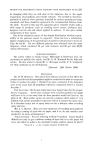
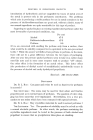
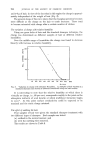
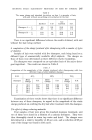
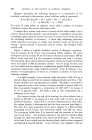
STUDYING STATIC ELECTRICITY PRODUCED ON HAIR BY COMBING 239 (ii) Both surfaces of the leaf and those of the backing plate were clean and free from grease. (iii) Apart from the portion in the clamp, the leaf was separated from the backing plate by as small a distance as practical. Separation was necessary to avoid the slight adhesion which otherwise caused the leaf to spring away rather violently from the backing plate during measure- ment. (iv) The leaf was then freed from creases and bends, and hung so that the bottom edge was a constant distance from the bottom of the backing strip. (v) The bottom of the leaf was exactly opposite the centre of the,tips of the comb's teeth during any part of the traverse movement of the comb. (vi) The utmost care was taken to avoid touching the leaf with the hair. The leaf was illuminated through the glass by a microscope lamp and viewed through a short-focus telescope, the leaf in silhouette being centred on the telescope cross wires as a reference point. To detect the charge, the rack and pinion was operated, moving the comb towards the leaf until the first detectable movement of the leaf towards the charged comb was observed. Readings were completed within ten seconds of the last stroke of the hair in the comb so as to avoid excessive charge leakage (see below). Charge removal Before a determination, it was obviously desirable to free the comb from any charge remaining from the previous test. The complete elimination of the charge was not easy where a number of determinations had to be carried out in quick succession. The best method used a number of 8" strands of thin wire tied together at one end and joined to a flexible wire connected to earth. The wire was drawn through the comb in a manner identical to that used in charging the hair. A large though variable portion of the charge was thus removed. Charge measurement The distance between the comb and leaf was measured to the nearest half-millimetre by the movement of a pointer, attached to the other end of the rack and pinion, moving across a centimetre scale. The zero reading was checked before each test, to ensure that the leaf had not become displaced. If the distance of the comb from the leaf, when the charge is first detect- able, is d, then the charge rr is given by rr = Kd 2 where K is a constant depending on the dimensions and design of the apparatus. Since this apparatus was used for comparative purposes only,
Purchased for the exclusive use of nofirst nolast (unknown)
From: SCC Media Library & Resource Center (library.scconline.org)