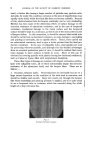
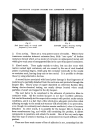
PRODUCTION AND PROPERTIES OF GLASS CONTAINERS otherwise satisfactory large scale tests on the mechanical strength of siliconed bottles, because the product packed in the bottles, a white petroleum emul- sion, whilst physically and chemically inert to the silicone, formed an unsightly condensation film on the interior of the bottles above the liquid level. This gradually coalesced into large drops which eventually ran down and formed a dilute layer on the surface of the emulsion, rendering the product unacceptable. After shaking the bottles, the process repeated itself after a few days. It was established that the condensed layer consisted only of water, and that a similar effect was produced with siliconed bottles filled with pure water. It was concluded that the sillconed bottles were unsuitable for use with aqueous pharmaceutical products, and the test run had to be completed using the jars for a non-aqueous ointment. FLAKING When bottles are boiled with water for a sufficient length of ti•ne, e.g., in the S.G.T. $ hour boiling test, insoluble flakes can appear, someti•nes dull but usually ghstening. They can also be produced by long continued action at room temperature, or rapidly and in abundance by treatment in an auto- clave. The preferential attack on the alkali of the glass by the water results. in the surface of the glass becoming relatively richer in lime and silica. If considerable hydrolysis occurs, a film of hydrated silica may also be produced on the surface and when dried would tend to peel off. But •vith or without much silica layer the surface, now having a composition distinctly different from the glass beneath may be expected to have different properties, thermal expansion for example, and thus to spall off on rise or fall of temperature. Turner 4 et al showed that such flakes, resulting from the storage of neutral aqueous solutions or water, consisted of 80ø,/0 or more silica with a little lime after washing with hot hydrochloric they had a composition approaching nearly 100% silica, showing that they were not flakes of glass itself, but of a decomposition product. Flakes from acidic solutions con- sisted almost entirely of silica and appeared as minute thin glistening particles which settled slowly, in quite a different manner from those produced by the reaction of alkaloid solutions with the alkali extracted from the glass. (As in the narcotine hydrochloride test.) The tendency of glass to produce flakes is well known to be dependent on the chemical composition, but unexpected results are frequently encountered. Turner quoted the use of two sets of bottles, both satisfactory in the 5 hour boiling tests as regards alkali extraction, but while one produced no flakes in 100 hours, the other produced flakes in 3« hours. The probable explana- tion of the discrepancy was, that the second set had been stored some months before testing, producing a slight filrn by atmospheric weathering which was loosened by boiling with water and produced flakes. Other workers have

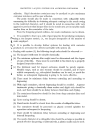
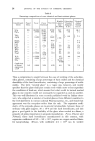
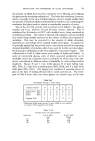
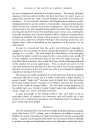
JOURNAL OF THE SOCIETY OF COSMETIC CHEMISTS also found that the tendency to flake cannot readily be predicted from the results of durability tests, as illustrated by the results of Bacon and Birch 5 shown in Table 5. In addition, l_•ister ø stated that while there was no differ- ence in alkali extracted in durability tests with bottles, the glass of which ,contained magnesia, the tendency to produce flakes in bottles containing Table 5 Tendency to Flake v Durability 5 oz. Bottles filled with distilled water and maintained at 95øC for 24 hrs. Titration in mg[x Bottle NaOH/litre Flakes -- B 15 -- D 19 F E 22 -- C 26 F G 28 F A 31 -- 1 38 F F 43 -- j 47 F H 50 F K 81 F alcoholic solutions was directly proportional to the magnesia content of the glass. Turner also pointed out, that the alkalinity of the solution produced by the water extraction tended to disturb the rate at which flakes accumu- lated• Flakes derived from water attack were maintained in contact for 24 hours at 100øC with sodium hydroxide solution, comparable in strength with that obtained at the maxin:um limit per•rissible in the 5 hour boiling test for 4 oz medicine bottles. ]'he flakes were found to dissolute slowly up to 50%, she, wing that, especially with bottles of less satisfactory character due to excessive soda content in the glass, flakes formed at an early stage may tend to go into solution again as the alkali concentration of the extract rises above a certain value. Flakes are also produced relatively quickly by the action of sodium phosphate, citrates, tartrates and saline solutions, and the application of silicones does not appear to give much protection. This is in line with the findings already referred to, which lead to the conclusion that the silicone fihns did not prevent the migration of sodium ions from the surface of the glass to any great extent. Although the most usual cause of the appearance of "flakes" is interaction between glass and bottle contents, there are other possible sources apart f•om the obvious one of glass splinters caused by faulty manufacture and handling. This possibility is one against which every glass manufacturer, and filler, is
Purchased for the exclusive use of nofirst nolast (unknown)
From: SCC Media Library & Resource Center (library.scconline.org)