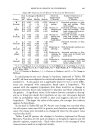
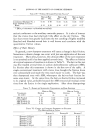
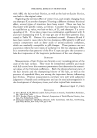
THE OSMOTIC BEHAVIOR OF HAIR DURING THE PERMANENT WAVING PROCESS AS EXPLAINED BY SWELLING MEASUREMENTS By Au•wr SsA•sn¾, PH.D.* THERE ARE three types of forces which hold protein molecules in groups: (1) covalent cross links, (2) electrostatic salt bridges and (3) hydrogen bonds. These forces are largely responsible for the mechanical properties exhibited by protein fibers. The protein molecules of fibers such as hair or wool have their long dimension aligned with the axis of the fiber. The most important forces which hold these long molecules to- gether in bundles are of the three types described above. The first of these is the covalent molecular cross link present in the cystine residues. The second is the salt bridge, which is the electrostatic attraction between op- positely charged side chain groups in adjoining molecules. Finally, there are hydrogen bonds between the NmH and C=O groups which are always present in protein fibers. These three types of lateral forces are important in determining the mechanical properties of fibers, and it is the purpose of this paper to report the effect of cold wave reagents on these three forces as characterized by the swelling and deswelling phenomenon of human hair fibers. Cold wave lotions generally consist of approximately 8% ammonium thioglycolate solutions adjusted with ammonia to a pH of about 9.3. They have the capacity for breaking all three types of bonds. The swelling of human hair is anisotropic that is, the diameter changes are much larger than the length changes (1). The most direct method of determining dimensional changes is to observe them under a microscope. Other workers(2) have undertaken such measurements and have arrived at the conclusion that natural fibers are so irregular and nonuniform and the volume changes so small that even a large number of microscopic measure- ments will usually fail to yield quantitative data of good precision. Never- theless, direct microscopic measurement has so much to recommend its use that it was felt the results obtained would be significant. In general, microscopic swelling measurements were made on short •engtns 3 cm.) of , had a dry diameter of 40-60 mu. The samples were mounted in a small * Rilling Dermetics Co., Bridgeport 7, Conn. 427

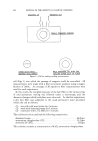
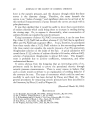
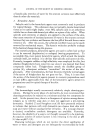
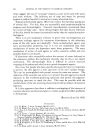
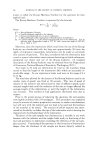
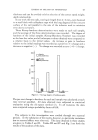
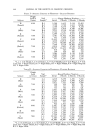
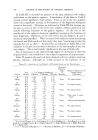
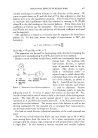
428 JOURNAL OF THE SOCIETY OF COSMETIC CHEMISTS REAGENTS IN REAGENTS OUT , FEMALE TH EADED OPENING COVER GLASS WITH MOUNTED HAIR SAMPLE MALE THREADED "O" RING FOR SEALING COVER SLIP IN PLACE Figure 1.--Cell for making swelling measurements. cell (Fig. 1) into which the passage of reagents could be controlled. All measurements were made with a filar micrometer eyepiece using a magni- fication of 260X. An average of 20 repetitive fiber measurements were used for each experiment. In this study, the complete exposure of the hair fiber to the various steps of cold permanent waving was followed under a microscope, and the diameter changes which took place were observed. In the first experiment, a dry hair fiber was subjected to the usual permanent wave procedure within the ceil as follows: (1) wet with cold wave lotion for 3 minutes (2) wash with deionized water for 1 minute (3) neutralize with 1.5% H202 for 5 minutes The cold wave lotion used had the following composition: deionized water .......................................... 66.8 gm. ammonium thioglycolate 52% ............................. 11.3 gin. ammonia 26-28% ......................................... 3.0 gin. This solution contains a concentration of 8.6% ammonium thioglycolate.
Purchased for the exclusive use of nofirst nolast (unknown)
From: SCC Media Library & Resource Center (library.scconline.org)