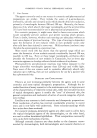
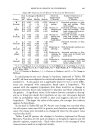
EFFECTS OF GELATIN ON FINGERNAILS 445 examined, and the type of nail defects observed were recorded. Following this examination samplings of three nails from each individual used in this investigation were taken and subjected to tests to determine the relative degree of hardness of each nail sample. The nail samples were collected on a random basis. In subsequent samplings the same nails were used as for the initial sampling. At intervals of one, two and five months following the start of this investigation--ingestion of supplemental gelatin or placebos --the nails of all subjects were examined and sampled for hardness testing, the same nails being sampled at each time interval as initially. In addi- tion, at the end of five months following initiation of the study all subjects were surveyed with respect to improvements in the condition of their nails which they observed. The data so obtained was later correlated with the observed changes noted by the investigator. Hardness testing was conducted with the use of a Kentron Micro-Hard- ness Tester ©* which employs the principle of indentation of a test sub- stance under a fixed weight. The Kentron Micro-Hardness Tester consists of a ridged beam mounted on flexure plates allowing normal rotational movement about only one axis. To the beam is attached an indenter and a test load. The indenter is held in an elevated position by raising the beam with a system of levers held in place by a latch. The indenter is allowed to descend at a selected constant rate of speed by releasing the operating lever. The speed of descent is controlled by a variable speed oil dash pot to which the beam is linked. The indenter will descend until it meets the surface of the specimen and completes the indentation. The indentation is measured with the aid of a standard metallurgical micro- scope provided with the hardness tester. The microscope is equipped with a filar micrometer eyepiece and the length of the indentation is measured in filar units. Filar units are converted into microns for subsequent cal- culations of the hardness number or value desired. (1 Filar Unit = 0.1 Microns) The indenter used in our research was the Knoop Diamond Indenter, which is cut in the shape of a diamond-based pyramid giving a diamond- shaped impression, in which the long diagonal is nearly seven times the length of the short diagonal. The included longitudinal angle, measured from edge to edge, is 172 ø 30', and the transverse angle is 130 ø 00'. Be- cause of the difference in the lengths of the two diagonals, almost all of the elastic recovery of the indentation made with the Knoop Indenter takes place in the transverse direction. Hence, the measurement of the long diagonal together with the computed indenter constant gives a very close approximation of the unrecovered projected area of the indentation in square millimeters. The relationship between the applied load in kilo- grams and the approximate unrecovered projected area in square milli- * The Torsion Balance Co., Clifton, N.J.

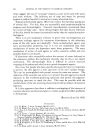
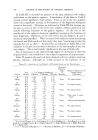
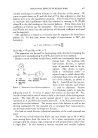
446 JOURNAL OF THE SOCIETY OF COSMETIC CHEMISTS meters is called the Knoop Hardness Number for the specimen for that applied load. The Knoop Hardness Number is expressed by the formula KN L L (,•:0) where KN = Knoop Hardness Number L = Load in kilograms applied to the indenter •/p = Unrecovered projected area in square millimeters l = Measured length of the long diagonal of the indentation in millimeters Cp = Constant relating "/" to the unrecovered projected area of the indentation. For an indenter with a longitudinal angle of 172 ø 30' and a transverse angle of 130 ø 00', Cp = 7.028 X 10 -• Moreover, since the impressions which result from the use of the Knoop Indenter are rhomboidal with the long axis approximately 30 times the depth of impression measurable, indentations can be made on extremely thin sections of specimen. This fact, considered with the observation that round or square indentations cause extreme fracturing on brittle substances, predicated our choice and use of the Knoop Indenter. (A complete description of the Knoop Indenter may be obtained from the Department of Commerce, National Bureau of Standards, Washington, D.C.) Test loads to be used are determined by trial on the materials being tested so that the length of the indentation falls within an accurately re- producible range. In our experiments loads used were in the range of 4.1 to 7.1 kg. The total time allowed for the descent of the Knoop Indenter used in our studies (rate of speed) was fixed at 20 seconds. This rate of speed of descent of the indenter was determined by trial of different speeds under selected weight loads until the reduction of the rate no longer affected the average length of the indentations or until the length of the indentation was constant. This method of load application eliminated error due to impact. Prior to the actual process of indenting the specimen, the nail samples were lightly polished with 3/0 sandpaper. This procedure was employed since the amount of surface preparation necessary to make a microhardness test will vary with the indenter and test load to be used and the hardness of the material to be tested. The amount of polish required was deter- mined by the ability to define the tips of the indentation and to develop the characteristic rhomboidal shape of the indentation. Thickness of the nail samples was eliminated as a variable in our work because with the indenter and the weight loads used, no fracturing of the test nail specimens or depressions exceeding the thickness of the nail sam- ples occurred. Fracturing of the specimen or the formation of indentations deeper than the thickness of the sample are factors directly related to
Purchased for the exclusive use of nofirst nolast (unknown)
From: SCC Media Library & Resource Center (library.scconline.org)