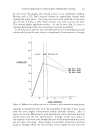
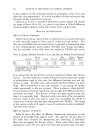
FRICTIONAL EFFECTS IN HUMAN HAIR 459 apparent that case C will not often be encountered. In combing, cases D and B will be most important. With regard to softness and manageability, cases A and E may also enter the picture. Unless otherwise stated, all tabulated measurements were made in the direction of lowest friction. B. Other Z'actors ,4ffectin Friction 1. Load. Although the classic law of friction states that the coefficient of friction is independent of the normal load (within wide limits), it is an experimental fact that t,he uk value of most friction systems involving fibers tends to increase substantially at very light loads. It is fairly constant, however, at high loads. Preliminary experimentation indicated that hair behaved like other fibers in this regard, and most measurements were made in a range where the load rs. • curve was substantially flat. 2. I•elocity. Relative velocity of the two rubbing surfaces has little effect on the value of u• in most dry or boundary lubricated systems, al- though it has a major effect in hydrodynamically lubricated systems. There is frequently a sizable difference, however, between u• (at any velocity) and us, the static coefficient of friction. This latter quantity can be measured directly by measuring the force necessary to start move- ment. It can be measured indirectly by extrapolating back to zero velocity the measured values of u• at progressively lower speeds. Unless the extrapolation is done very painstakingly, the two values will frequently disagree. In the present discussion we shall limit ourselves to values of 3,2 measured in ranges where the curve of velocity rs. • is substantially flat. 3. ]•hysical and Chemical Nature of the Rubbing Surfaces. Since friction is a manifestation of interaction at the solid-solid phase boundary and is strongly dependent on the free energy of the interface, it is to be expected that u• will be a characteristic property of the pair of rubbing surfaces. Changes in the surface of either rubbing element will, in general, change the friction. Surfaces of all solids, including those that are essentially non- swellable and impermeable, can be altered by the presence of adsorbed monomolecular layers or by the presence of imperceptible coatings of multimolecular thickness. These latter coatings, as well as the mono- layers, may be continuous or patchy. The surface properties, and there- fore the friction, of hair can be modified by several additional factors: (a) Moisture content has a considerable effect on hair friction. Con- sequently, measurements should be at controlled humidity and temperature. Wet measurements are preferably made under the liquid medium after the hair has had a chance to equilibrate completely. (b) State and degree of modification of the keratin substance composing the hair affects friction, and also affects the response of hair friction to moisture. (c) The presence of soluble materials sorbed from solution, but not necessarily present as a surface coating, can affect hair friction. The most important substances

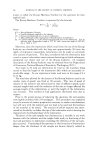
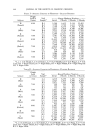
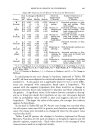
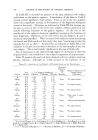
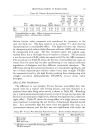
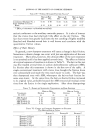
460 JOURNAL OF THE SOCIETY OF COSMETIC CHEMISTS in this category are the surfactants present in shampoos, creme rinses and other hair care preparations. It is with the effects of these substances that the present study is primarily concerned. Values of Uk in dry or boundary lubricated systems seldom fall outside the range of about .05 to 1.0 i.e., there is only about a 20-fold difference between a highly slippery system and one that tends to grip or bind RESULTS AND DISCUSSION Effect of Farious Subslrates Table I shows the •k values of hair on itself and on six smooth specimens of solid materials typical of those used in combs and hair devices. The hair was unmodified and was cleaned prior to testing by shampooing twice in 2% triethanolamine lauryl sulfate (TEALS) and rinsing thoroughly. The test mandrels of the solids were also washed in TEALS and rinsed. TABLE I--TYmcaL DYNAMIC FRICTION VALUES (/Zk) HAIP. Olq SMOOTH SOLID SUR. FACES* Alumi- Poly- Hard Hair-on- Lucite1: numl: Glass1: Nylon1: ethylenes Rubbert Hairt Dry 0.19 0.12 0.14 0.22 0.19 0.15 Wet 0.45 0.18 •'.5} 0.22 0.29 0.38 0.34 * Unmodified hair, 2% TEALS wash q- two 2 minute rinses. t Single fiber values averaged. S Tapes of hair used. It is evident that the wet friction is, without exception, higher than the dry friction. In some instances, notably aluminum and the particular sample of polyethylene used in this test, the difference between wet and dry friction is small. In other cases, such as lucite and hard rubber, it is quite large. Most noteworthy is the wide variation in •k among the various solids, particularly in the wet systems. There is almost a three-fold dif- ference between aluminum and Lucite and an eight-fold difference between aluminum and glass. The friction of clean wet glass against clean wet hair, 1.4, is unusually high. Identical combs were made of the six materials listed in Table I and were used to comb wet, unmodified hair (both in tresses and on heads) that had been shampooed with TEALS. The rating of the various combs with regard to ease of combing correlated completely with the friction values. Effecl of Shampoo Treatments Table II shows the effect of different shampooing treatments on the friction of unmodified hair against itself. The data for the first part of this table were obtained by shampooing and measuring 12 individual fibers and averaging the friction values. These same fibers were then shampooed in the next test bath until they had attained their new equi-
Purchased for the exclusive use of nofirst nolast (unknown)
From: SCC Media Library & Resource Center (library.scconline.org)