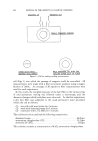
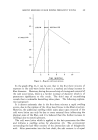
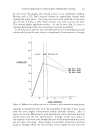
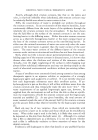
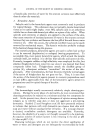
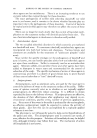
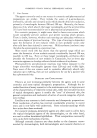
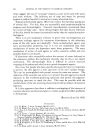
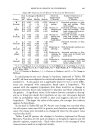
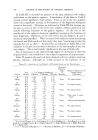
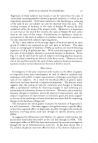
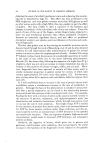
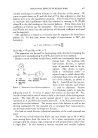
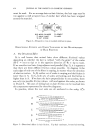
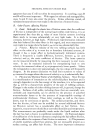
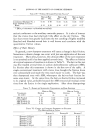
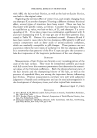
FRICTIONAL EFFECTS IN HUMAN HAIR 457 started revolving at uniform velocity in the direction of the arrow. W• starts to push down on P, and the dial of T is then adjusted so that the balance arm is in the equilibrium position. The frictional force required to maintain this equilibrium while the mandrel is moving is W-(W•-R) where R is the dial reading on the torsion balance. From these data the coefficient of friction can be calculated. The area of contact between H and M does not enter into the calculation of frictional coefficient and need not be measured. The calculation is based on a formula used by engineers for belt-driven pulleys (3). In this case, where the angle of encirclement is 180 ø , the formula is: Uk = coeoe. of friction = 0.733 log Ms Mo where Ms = W and Mo = W• - T. The apparatus can be used for determining static friction by keeping the mandrel static and adjusting T until W•just starts to move upward. Roeder's work involved textile fibers, which are considerably finer than wi w H- HAIR M- MANDREL P ~ BALANCE ARM T - TORSION BALANCE W,W I - WEIGHTS Figure 1.--Schematic view of friction apparatus. human hair. For working with hair-on-hair friction, a special type of mandrel had to be de- signed. This device is essen- tially a "cylindrical zither" or squirrel cage in which about fifty individual hairs form the periph- ery of the cylinder, as shown in Fig. 2. A and B are the two sec- tions of the cylinder, each about 1/2 inch in diameter. Section A is threaded axially to take the adjusting screw S. S serves to adjust the tension on the hairs H. Sec- tion B is fitted with a stem C which is held in the chuck of the driving mech- anism. The hairs H are evenly spaced about 1 mm. apart and are cemented to A and B by the cement layers D. A du Nuoy tensiometer is used as the torsion balance. The torsion arm of the balance as well as the driving mechanism for the mandrel are so arranged that measurements can be made under water to obtain wet friction. For hair-on-comb friction cylindrical mandrels of the comb material are used. The friction of individual hair fibers can vary widely (up to 30 or 40%) even among hairs from the same lot. It is often convenient to get an average value by using a tape composed of well arrayed hairs rather than a single fiber. In this method a heavier mandrel and sturdier balance

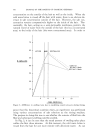
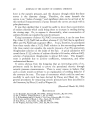
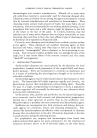
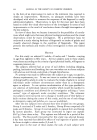
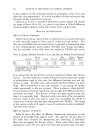
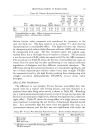
458 JOURNAL OF THE SOCIETY OF COSMETIC CHEMISTS must be used. For an average hair-on-hair friction, the hair tape may be run against a well arrayed tress of similar hair which has been wrapped around the mandrel. B H A D •' •'D A, B- WOOD CYLINDER D- CEMENT C-DRIVE SHAFT H- HAIRS S-SET SCREW Figure 2.--Perspective view of mandrel with hair in place, DIRECTIONAL EFFECTS AND OTHER VARIABLES IN THE MEASUREMENT OF HAIR FRICTION zl. The Direclional Effect It is well known that animal hairs show different frictional values depending on whether the hair is rubbed "with the grain" of the scales (R-T = root to tip) or in the opposite direction (T-R = tip to root). If we consider two hairs lying adjacent and parallel (Fig. 3), it is apparent that there are three different friction values possible. In diagram A the scale edges of only one of the fibers is rasping, no matter what the direction of relative motion. In B, neither set of scales is rasping, and the friction is lower than in A. In C, both sets of scales are locking, and the friction is higher than in A. If we have the hairs perpendicular to one another, there are only two possible friction values: with and against the scales, as shown in D and E. All cases of sliding hair-on-hair friction can be resolved into th• components represented by these five diagrams. In practice, where the root ends are all anchored in the scalp, it, •is E Figure 3.--Directional effects in hair friction. A R R• T R • ••T C R T• R D R• T Top hair stationary, bottom hair moving.
Purchased for the exclusive use of nofirst nolast (unknown)
From: SCC Media Library & Resource Center (library.scconline.org)