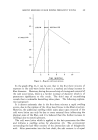
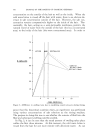
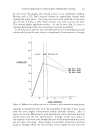
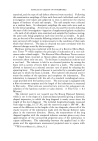
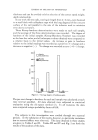
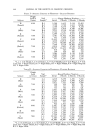
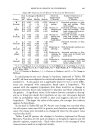
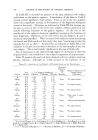
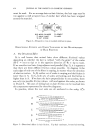
OSMOTIC BEHAVIOR OF HAIR DURING PERMANENT WAVING 431 be seen from the graph, this rinsing results in an additional swelling. Rinsing with a 1% NaC1 solution showed no appreciable change from rinsing with water alone. Since the cold wave lotion used had a concentra- tion of salt of 8.6%, a 10% NaC1 solution was used to rinse the hair. This showed highly significant results. As can be seen (Fig. 3), there is complete flattening of the curve, showing no increase in swelling. In all three cases, the hair was neutralized with a 1.5% hydrogen peroxide solution and, as can be seen, there is a significantly lower amount of energy SWELLING 70- 60- 50 40 30 2O 10 LOTION 2 NEUTRALIZE 2• NaC1 Wash 3 • NaC1 Wash 5• NaCI Wash I I I ß 6 8 10 TIME (MINUTES) Figure 4.--Difference in swelling rates due to variation of salt concentration during rinsing. required to deswell the hair with the neutralizer if the hair is first rinsed with the more highly concentrated sodium chloride solution. This is borne out by the differential in area beneath the curves between the four minute point and the nine minute point. Energy, in this case, refers to the capacity to do work even though the units of the area beneath the curve are not those of energy. Since energy is a product of the force and the distance through which the force moves, it can readily be seen that the

432 JOURNAL OF THE SOCIETY OF COSMETIC CHEMISTS force is the osmotic pressure, and the distance through which the force moves is the diameter change. Therefore, the areas beneath the curves is an "index of energy," and significant data can be arrived at by this method if measurements of areas beneath the curves are made with a polar planimeter. It was then decided that it would be useful to know that concentration of sodium chloride which could bring about no increase in swelling during the rinsing step. Or, to express it theoretically, what concentration of sodium chloride can equalize the osmotic pressure. Using increments of about 1% NaC1 concentration, it can be seen from Fig. 4 that 21/2% NaC1 had no effect, whereas 31/2% NaC1 had a significant effect and 5% NaC1 had no greater effect. It can, therefore, be postulated from these results that a 31/•% NaC1 solution in the surrounding medium (the rinse water) can equalize the osmotic pressure of an 8% ammonium thioglycolate solution on the inside of the hair. A quick calculation will reveal that a 31/•% solution of sodium chloride is 0.6 molar, while an 8.6% solution of ammonium thioglycolate is almost 0.8 molar. This disagree- ment is probably due to activity coefficients, temperature, and other undetermined factors. It seems obvious from the foregoing that an interesting series of ex- periments could be devised to prove the postulated theories through osmotic pressure measurements. There is every reason to believe that such a study would contribute to an explanation of swelling behavior if the converse be true. The type of osmometer which could be used suc- cessfully in such work has been devised by Fuoss and Mead (4). The general procedures for measuring osmotic pressure have been described in the literature, by Flory (5) and by Wagner (6). (Received March 26, 1963) REFERENCES (1) P. Alexander, Research, 24, 246 (1949) Melliand Textilber., 31, 550 (1950). (2) M. T. Rollins, Textile Research J., 17, 19 (1947). (3) J. B. Speakman and S. G. Smith, J. Soc. Dyers Colourists, 52, 121 (1936). (4) R. Fuoss and D. J. Mead, J. Phys. Chem., 47, 58 (1943). (5) P. J. Flory, J. ztrn. Chern. Soc., 65, 372 (1943). (6) H. Wagner, Ind. Eng. Chem., .4nal. Ed., 16, 520 (1944).
Purchased for the exclusive use of nofirst nolast (unknown)
From: SCC Media Library & Resource Center (library.scconline.org)