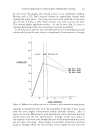
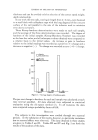
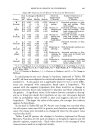
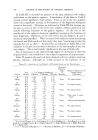
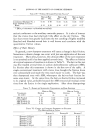
EFFECTS OF GELATIN ON FINGERNAILS 453 regimen at the end of one month through utilization of body amino acids for this purpose. However, the continuing effect of gelatin in producing an increase in the hardness of fingernails, when compared to the observed effect of lactose, could be explained through the fact that gelatin is provid- ing amino acids of a specific nature, thus suggesting a function of gelatin other than a general source ofamino acids. The rapid rate of response to gelatin observed in our work, one month of gelatin regimen resulting in a significant increase in the hardness of most all of the nails in five out of seven subjects, again supports the concept of a specific effect of gelatin despite the fact that in all probability all the areinc acids contained in gelatin are ingested in ordinary daily diets. This is particularly significant in view of the dose administered, 2.0 g. per day. Additional studies using even lower doses of gelatin would shed light on this specific effect of gelatin. It is also interesting to note that with continued intake of 2.0 g. of gelatin there is a continuation of gelatin's effect on the hardness of nails. The data suggests that this effect is specific and con- stant. With continued gelatin administration the net gain in hardness increases monthly. The significance of this observation is not evident at this time. Only further studies on a time-dosage basis would establish whether this increase in hardness would continue in a linear fashion or would plateau to a constant value in terms of hardness related to the dosage being administered. SUMMARY AND CONCLUSIONS Data has been accumulated which indicates that the daily ingestion of 2.0 g. of gelatin increases significantly the hardness of fingernails and apparently improves nail defects in normal subjects. Observations made show that the response of the fingernail to gelatin, as measured by changes in hardness, occurs within one month following ingestion of gelatin on a daily basis in five out of seven test subjects. A slight increase in the hardness of the nails of subjects on the placebo capsule regimen was observed, although no improvement in apparent nail defects was obtained. The use of the technique of measuring the hardness of fingernails as a tool for evaluating the effects of gelatin (or other substances) is discussed. The results are discussed in terms of a "specific" action of gelatin with the effect of gelatin on fingernails occurring through either specific dynamic action or metabolism of the amino acids inherent in gelatin. /lcknowledgment: We are indebted to Mr. Charles Burr of the All- Purpose Gelatin Products Company, El Segundo, California, for his assistance and for the supplies of gelatin and placebo capsules used in this study. (Received May 2, 1963)

454 JOURNAL OF THE SOCIETY OF COSMETIC CHEMISTS REFERENCES (1) T. T. Tyson, •rnvest. Dermatol., 14, 323 (1950). (2) T. H. McGavack,/intibiotic Med. & Clin. Therapy. 7, IV (1957). (3) S. Rosenberg, K. Oster, A. Kallos, and W. Burrough,/I.M./I./lrch. Dermatol., 76, 330 (1957). (4) S. Rosenberg and K. Oster, Conn. StateMed. f., 19, 171 (1957). (5) M. Schwimmer and M. G. Mulinos,/intibiotic Med. & Clin. Therapy, 4, 403 (1957). (6) J.L. Derzavis and M. G. Mulinos, Med./inn. Dist. Columbia, 3, XXX (1961). (7) G.W. Shedecor, StatisticalMethods, Iowa State College Press (1950). (8) D. Rapport and H. H. Beard, 7. Biol. Chem., 73, 299 (1927). (9) W. R. Beavers and B. G. Covino, Proc. Soc. Exptl. Biol. Med., 92, 319 (1956). (10) K. O. Godwin, 7. Nutrition, 69, 121 (1959). (1 I) H. Borsook, Biol. Revs. Cambridge Phil. Soc., 11, 147 (1936). (12) R. M. Block,/Inn. N.Y./icad. Sci., 53 (1951). (13) Castello v. Pardo,/irch. Dermatol. and Syphilol., 70, 182 (1954).
Purchased for the exclusive use of nofirst nolast (unknown)
From: SCC Media Library & Resource Center (library.scconline.org)