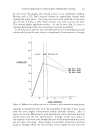
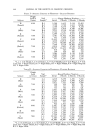
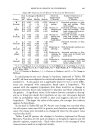
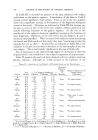
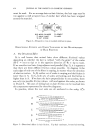
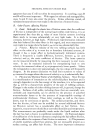
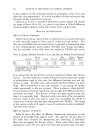
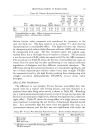
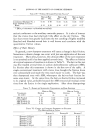
FRICTIONAL EFFECTS IN HUMAN HAIR 463 with ABS, the hair-on-hair friction, as well as the hair-on-Lucite friction, was back to the original value. Neglecting the extreme effect of creme rinse, and simply changing from one shampoo X to another shampoo Y having a different ultimate frictional effect, several types of transition have been noted. These can best be illustrated with specific values, as follows: Consider that shampoo X has an equilibrium Uk value, wet hair-on-hair, of 25, and shampoo Y a corre- sponding of 32. If we take a tape-tress combination equilibrated with X and start shampooing with Y, we may get any of the three patterns illus- trated in Table VI. Pattern A is considered normal. Patterns B and C have been noted in cases where the two shampoos differ greatly in pH and contain components such as fatty acids or anionic-cationic complexes, which are markedly susceptible to pH changes. These patterns are not uncommon where the ionic types of surfactant in the two shampoos differ. It is noteworthy that patterns of the B or C type can give the consumer a false first impression of the long-term performance of her new shampoo. SUMMARY Measurements of hair friction can furnish a very revealing picture of the state of the hair surface. They must be interpreted carefully and made with full control over the numerous parameters that determine the numeri- cal values of the frictional coefficients. Both the physicochemical state of the hair keratin and the shampooing history of the hair, as well as the presence of superficial films, are among the important factors influencing hair friction. Friction measurements correlate very well with subjective judgments of handle and combing ease and can be used advantageously in the development of shampoos, rinses, and other topical hair treatments. (Received April 17, 1963) REFERENCES (1) H. G. Howell, K. W. Mieszkis and D. Tabor, Friction in Textiles, Textile Book Publishers, Inc., New York, 1959. (2) H. L. Roeder, Physics of Fibrous Materials, Symposium of Dutch Physical Society, Am- hem, The Netherlands, 1950. (3) Mechanical Engineer's Handbook, edited by Colin Carmichael, 12th Ed., 7th Printing, John Wiley & Sons, New York, 1950, pp. 1544.

BOOK REVIEWS SURFACE CHEMISTRY, Theory and Industrial Applications, by Lloyd I. Osipow. Reinhold Publishing Corp., New York. 1962. Ameri- can Chemical Society Monograph 153, 459 pages, indexed. Price $13.50. This collection of related essays on the chemistry of surface active agents is a remarkable testimony to the breadth and variety of interests developed in the intensive, serious and competent study of detergents in a commercial laboratory. It ranges over the chemistry of surfac- rants and the basic theoretical chemistry of this field but does not extend to other fields of surface chemistry. The book is in many ways an interesting one, and the author's general clarity of presenta- tion makes it pleasant and often stimulating reading. In the interests of not confusing the reader the author arbitrarily selected for discussion those ideas which appeared most credible, rather than present conflicting interpre- tations. This point of view is ten- able for many classes of technical exposition, but it removes the book from the generally accepted defini- ,- .... ,.r ",monograph" r.,• .l. o stated in the General Introduction prefacing this and other members of the ACS Monograph series) and may, indeed, disappoint readers who anticipate a monograph treatment. It would be too much to expect that a single review of surfactant chemistry, of less than 500 pages, would, for the cosmetic chemistry laboratory, make any significant contribution to the literature of surfactant chemistry of interest to cosmetic science--and no such ex- pectation is realized here. The chapter on emulsions certainly can- not replace any of several good discussions on this subject which are readily available and already on the shelves of almost all cosmetic chemistry libraries. The scanty lit- erature of cosmetic detergency is not cited or discussed in the chapter on detergency, which, indeed, only discusses some of the more recent and elegant work in textile and fiber detergency. The outline of surfac- rants (Chapter 8) is rudimentary and too limited to be of value in the cosmetic chemistry laboratory. The earlier chapters, dealing with theoretical surface chemistry and fundamental physical chemistry, are concise outlines, serving as brief refreshers prior to the later chapters but with insufficient development to serve as an introduction to fundamental surface chemistry. This conciseness gives an episodic character to this section. Indeed, there is sometimes a lack of con- cordance, as when, in the first chapter, an equation stating the numerical equivalence of surface tension to specific surface free energy is characterized as a "fundamental relation of surface chemistry," while in Chapter 10 this numerical equivalence is termed merely a common assumption, and, from newly stated definitions of the two quantities, this later discussion pro- ceeds to develop a different equation relating them. The abundance of typographical errors is unfortunate and even much 464
Purchased for the exclusive use of nofirst nolast (unknown)
From: SCC Media Library & Resource Center (library.scconline.org)