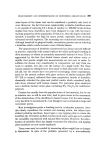
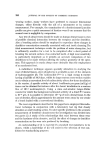
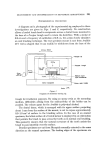
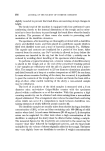
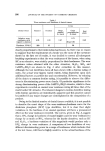
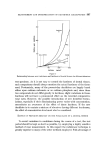
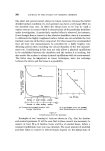
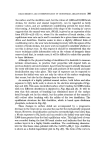
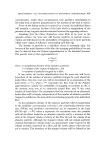
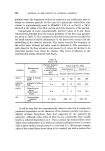
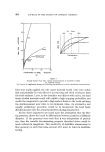
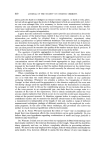
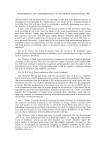
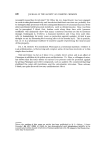
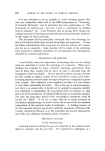
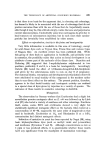
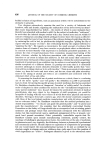
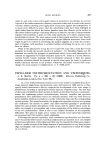
396 JOURNAL OF THE SOCIETY OF COSMETIC CHEMISTS Table I Wear resistance and hardness of dental tissues Ivory Dental tissue Enamel Dentine Grain Grain End parallel perpendicular grain to track to track -- Relative wear 0.71 resistance with 4.25 1.00 0.67 0.45 respect to dentine Mean 0.61 Hardness, HV2.5 280 57 28 closely proportional to their indentation hardnesses. As there was no reason to suppose that the employment of a brush was the cause of the curvature shown by the first set of results, it was decided to correct all subsequent brushing experiments so that the wear resistances of the tissues, when using SiC as an abrasive, were strictly proportional to their hardnesses. The wear resistance values obtained with the other abrasives, A1203, SiO 2 and CaHPO4.2H20 are shown in FiR. $ after correction in this manner. Although the test dentifrices have all been shown with a dentine rating of unity, the actual wear figures varied widely, being dependent upon such additional factors as particle size and concentration. However, by reducing all the data to a common dentine rating, it is possible to observe the differ- ences in discriminating power more clearly. Of particular significance is the strong discriminating power of the CaHPO 4.2H20 abrasive, which in these experiments recorded an enamel wear resistance rating 40 times that of the much harder SiC abrasive. The inherent dangers in routine dentifrice testing with dentine specimens are immediately apparent and this practice cannot be justified if any major changes are contemplated in the composition of a product. Owing to the limited number of dental tissues available, it is not possible to describe the exact shape of the wear-resistance/hardness curve for the dicalcium phosphate (DCP) type dentifrice, but it is clear that slight variations in the hardness of an enamel specimen will have a pronounced effect on the wear resistance recorded. The curves, given in FiR. 8, suggest that a 10% change in hardness of enamel might cause its wear resistance to change by as much as 50%, whereas for the harder abrasives, such as SiC and A120 3, a hardness variation of this magnitude would produce only a 10% change in wear resistance. A comparison of two dentifrices of very different discriminating power in a range of hardnesses which includes that of the test tissue, will thus be highly sensitive to the actual hardness of the

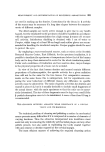
MEASUREMENT AND INTERPRETATION OF DENTIFRICE ABRASIVENESS 397 30- Dentifrice / •C • IO- / Tvory Dentine el 0 100 200 300 Hardness, kg/rnm 2 Relatlonsh[p between wear resistsnce snd test specimen. As it is not easy to control the hardness of dental tissues, such comparisons should always mention the actual hardness of the tissue used. Fortunately, many of the present-day dentifrices are largely based either upon calcium carbonate or on calcium phosphate and, since these two compounds do not differ greatly in hardness, slight variations in tissue hardness will not have a pronounced effect on the recorded comparative wear rates. However, the possible introduction of new dentifrice formu- lations, especially if their discriminating power varies with concentration, necessitates an awareness of the effect of tissue hardness. If the new dentifrice is to contain a mixture of abrasives having different hardnesses, the effect of concentration level must also be considered. EFFECT OF PREVIOUS HISTORY ON THE WEAR RATE OF A DENTAL TISSUE To avoid variations in conditions during the course of a test, the test period should be kept as short as possible, by employing a highly sensitive method of wear measurement. In this respect the radiotracer technique is greatly superior to many of the other methods employed. Full advantage of
Purchased for the exclusive use of nofirst nolast (unknown)
From: SCC Media Library & Resource Center (library.scconline.org)