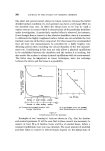
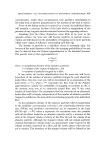
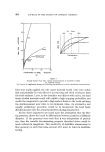
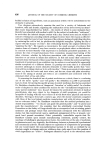
400 JOURNAL OF THE SOCIETY OF COSMETIC CHEMISTS similar to the conditioning curve obtained for a mechanically prepared enamel surface. As many soft drinks contain citric acid, the damage caused by excessive consumption of this form of refreshment requires further study. Not all 'running in' phenomena experienced during the testing of dentifrices can be attributed to such factors as mechanical or chemical damage to the surface, since a very similar effect can be observed with carelessly prepared enamel specimens. As many dentifrices are highly dis- criminating towards tissues of different hardness, even a small percentage of dentine remaining on a prepared enamel specimen can greatly increase the initial wear rate for example 1% could quite easily double it. This effect is greatly accentuated by the use of a brush, since this permits the softer regions of the surface to be indented below its mean level before the fibre loading in these regions is sufficiently lowered to give the same wear rate as the rest of the surface. The use of a rigid flat lapping plate to load the abrasive will clearly give a much reduced 'running in' effect, since the load distribution will rapidly readjust itself to give a uniform wear rate over the whole surface. The measured wear rate of the surface in this equilibrium condition will be given by the additivity rule n I• I•nVn, 1 where en and Vn are the wear resistance and volume concentration of the n th component of a heterogeneous surface (8). The presence of a small percentage of dentine will now have very little effect, even with a highly discriminating dentifrice. The same selective removal of the softer tissues will apply even to sound enamel as there will be slight variations in its surface hardness. In the case of a highly discriminating dentifrice this will be recorded by a pronounced roughening of the surface and lack of lustre. A very hard abrasive compound such as alumina, will reduce this degree of mechanical 'etching' of the surface and yield a higher lustre value than abrasives such as chalk or dicalcium phosphate dihydrate, which are commonly used. THE INFLUENCE OF ABRASIVE CONCENTRATION ON TOOTH WEAR For highly angular abrasive particles and relatively small depths of surface indentation, the overall wear rate of two sliding surfaces separated by a layer of the particles will be, to a large extent, independent of particle

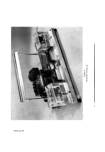
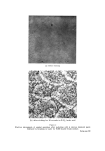
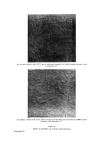
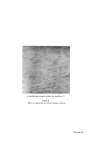
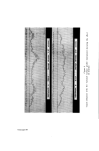
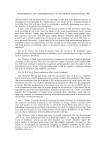
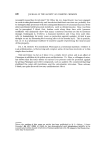
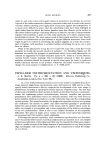
{c) equilibrium enamel surface for dentifrice 'C' Figure 6 Effect of dentifrice on etched enamel surfaces Facing page 400
Purchased for the exclusive use of nofirst nolast (unknown)
From: SCC Media Library & Resource Center (library.scconline.org)