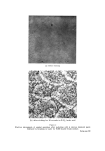
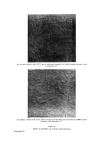
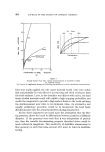
MEASUREMENT AND INTERPRETATION OF DENTIFRICE ABRASIVENESS 403 might be better described as an oblate spheroid. As the fibres will be in- clined to the tooth surface when brushing, the effective radius of the tip will be slightly less than that of the fibre cross-section. This may explain why the experimental values of • are smaller than the theoretical values. It is also likely that the diverging region of the trapped volume will be less efficient in causing particle abrasion than the converging leading zone and this factor alone could reduce all the theoretical • values by a half (tiddly- wink action). Bearing these factors in mind, the agreement between theory and experiment is remarkably good. It is interesting to note that over the usual dentifrice concentration range employed in oral brushing, approximately 1-5 particles are trapped by each fibre, assuming particle sizes ranging from 14-10 it. Thus one sweep of a brush containing 1,500 fibres might be expected to cause the whole surface to be traversed once by abrasive matter and 15 strokes should be adequate to remove a soft overlayer of 10-50 It thickness. The above theoretical analysis applies only to a mono-disperse system where all the particles are assumed to be of approximately equal size and abrasiveness. In practice, dentifrices contain abrasive particles of a fairly wide range of diameters and, in some cases, mixtures of compounds of sharply contrasting abrasiveness. The combination of these two factors can lead to a variation of • with concentration level. Consider, for instance, a mixture of finely divided and coarse particles of similar abrasiveness. Initially at low concentrations the finer matedhal will dominate the wear rate/concentration characteristic, but as the dentifrice concentration is increased, the coarser material will prevent the fine abrasive playing a major role and • will decrease. Such an effect is probably occurring with the SiC abrasive used to obtain the result shown in Fig. •. In this case there was a wide range of particle sizes present and a simple exponential function did not adequately describe the results. Initially, the magnitude of [I was in accord with the value one might associate with the very finely divided component of the abrasive but this slowly decreased to 13 which is a value more typical of coarse particles of about 14 I•. These results do not take into account the actual concentrations of the various components and thus tend to give rather low values for •. In practice, advantage could be taken of this ability of a dentifrice to make use of different particle sizes at different concentration levels. Thus a dentifrice, composed of a mixture of a very fine hard abrasive compound and a coarse soft matehal, would exhibit a discriminating power that varied with the actual concentration of the dentifrice being used. If such a denti-

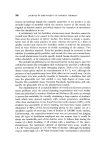
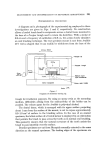
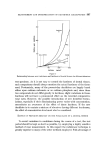
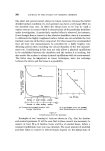
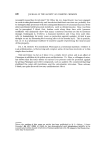
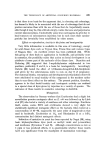
404 JOURNAL OF THE SOCIETY OF COSMETIC CHEMISTS 5,0 4.0 2.0 3 o IO 20 30 Concentral'ion of solids, %(vol/vol) (a) Oral Range Lower Test Concentration Upper _ (b) Figure 7 Dental tissue wear rate versus concentration of dentifrice solids (a) Typical curves (b) Curves to emphasise danger of selecting an arbitrary level of dentifrice concentration frice were orally applied, the soft coarse material would come into action first and probably be very effective in removing soft thick overlayers from the teeth surfaces. Later, as the dentifrice was diluted with saliva, the hard finely divided material would still exhibit a high trapping probability and enable the compound to provide a high surface lustre to the teeth and keep the dentine/enamel wear ratio to its minimum value. An alternative and equally satisfactory procedure would be to incorporate the hard finely divided abrasive into the actual brush fibres during manufacture. All the above arguments are based upon the assumption that the fibre tip geometry allows the brush to differentiate between particles of different diameter. If the geometry were such that • was independent of particle size, then the variable discriminating property described above would be much reduced in magnitude. This sensitivity of dentifrice abrasiveness to fibre geometry is such that some account of it must be taken in dentifrice testing.
Purchased for the exclusive use of nofirst nolast (unknown)
From: SCC Media Library & Resource Center (library.scconline.org)