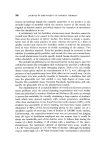
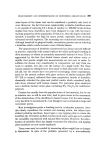
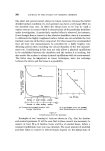
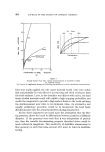
MEASUREMENT AND INTERPRETATION OF DENTIFRICE ABRASIVENESS 401 concentration. Under these circumstances each particle's contribution to the total wear is directly proportional to the fraction of the load it carries. If one of the sliding surfaces is replaced by a brush, the individual fibres will transmit a constant fraction of the load which is independent of the presence of any trapped abrasive material between the opposing surfaces. Assuming that the fibres themselves cause little or no wear to the opposite surface, the wear rate will become sensitive to particle concen- tration and will depend on the probability of trapping one or more particles within some 'region of influence' surrounding each fibre tip. The density of particles in a dentifrice slurry is extremely high, but because of the small diameter of the fibre the trapping probability is low and may be derived from the Poisson approximation to the binomial theorem. The general term of this approximation is e-nvnrvr , r! where n----population density of the abrasive particles, v=volume of the 'region of influence', and r=number of particles trapped by a fibre. If one makes the further simplification that the wear rate will be in- dependent of the number of abrasive particles trapped by each abrasively loaded fibre, then the wear rate will be determined by an expression of the form wN(1- e-nv), where e -nv represents the first term of the Poisson approximation, namely the probability of trapping no particles (r----O), w the intrinsic wear rate of an abrasively loaded fibre and N the total number of brush fibres. The assumption that the wear rate of an abrasively loaded fibre will be largely independent of the number of abrasive particles trapped is justified on the basis of the load-sharing property of an individual fibre. As the population density of the abrasive particles will be proportional to the dentifrice concentration (vol/vol), C, the relationship between wear rate, dW/dS, and dentifrice concentration can be expressed in the form dW/dS=a(1 -e-[ IC) where a represents the maximum wear rate possible with all the fibres loaded in an abrasive capacity and [I a measure of the ratio of the trapped volume of slurry at the fibre tip and the volume of an abrasive particle. Although the trapped volume will not remain perfectly constant throughout a brush stroke, an approximate value is given by the volume of slurry entrained by a fibre and the tooth surface when the two are in contact. The boundary of the trapped volume will be defined by the

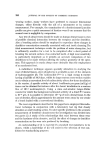
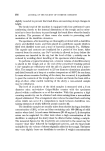
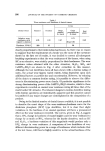
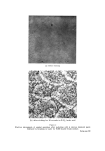
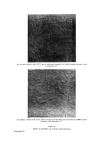
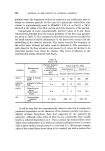
402 JOURNAL OF THE SOCIETY OF COSMETIC CHEMISTS position where the separation of the two surfaces is just sufficiently wide to accept an abrasive particle. In the case of a spherically ended fibre, this volume is approximately equal to 10/9•Rd 2, if R d, so that [t •_ 7R/d, where R is the radius of the fibre section and d the diameter of the particle. Comparisons of some experimentally derived values of [I and those obtained theoretically from the known geometry of the fibre and particles are given in Table II. The calculated values have been corrected to allow for the small amount of elastic deformation of the fibre-tooth contact and the embedding of the abrasive particles. The former extends the boundary of the active zone, whereas the latter tends to diminish it. This correction is quite large for the finer abrasives and causes the [t values for dentine to be somewhat greater than those for enamel. This trend is followed in the experimental results obtained with A120 3. Table II Values of [I Particle diameter I Values of [i (R= 100g) (diameter Manufacturer corresponding Experimental Theorical Abrasive and to mean volume, / /-- product (•3)• all particles 1 g Enamel Dentine Enamel Dentine __ A1203 Griffin & George I ($/20) $ g ! 130 168 290 '• $90 CattPO4. Albright & Wilson _ 21-I20 (SM) 12 g $0 30 59.0 59.5 , CaCO 3 Gibbs Proprie- taries (Waterworks 15 I1 8 8 47.5 48.0 Chalk) . -- SiC Carborundum Company (2 - 20 it) (400 - 13) (650 - 35) (700) It will be seen that the experimentally derived values for D confirm the predicted dependence on the diameter of the abrasive particle, but show a slightly stronger dependence than that suggested by the spherical tip geometry. Although other forms of fibre tip are conceivable, they usually lead to a reduced dependence on d. Thus a conical tip would yield [t values which were independent of d, whilst an inclined cylindrical form in contact with a plane surface would cause D to vary with d-L Microscopic examin- ation of the actual fibres shows them to be rounded, but with a surface that
Purchased for the exclusive use of nofirst nolast (unknown)
From: SCC Media Library & Resource Center (library.scconline.org)