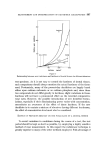
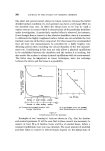
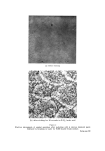
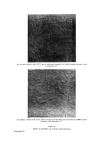
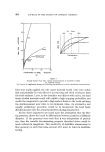
MEASUREMENT AND INTERPRETATION OF DENTIFRICE ABRASIVENESS 407 The above considerations also clearly show that lapping pad machines should be discouraged, since they cannot reproduce the interaction between the brush fibres and the dentifrice abrasives. 4. It has been well established that in situations where there has been a change in environment or surface contour, it is important to carry out a conditioning run prior to any test evaluation of a tissue/dentifrice com- bination. This precaution is particularly necessary when a radiotracer technique of wear measurement is employed, since the number of brush strokes required to obtain a measurable amount of wear is small in com- parison to other test methods. This high sensitivity of the radiotracer technique makes it particularly valuable for future investigations of the 'running in' phenomenon. ACKNOWLEDGEMENTS This paper is published by permission of the Director of the National Engineering Laboratory, Ministry of Technology. It is Crown copyright and is reproduced by permission of the Controller of H.M. Stationery Office. The authors wish to express their thanks to Professor H. W. Wilson for the irradiation facilities offered at the Scottish Research Reactor Centre. (Received.' l•tth November 1966.) REFERENCES (1) Souder, W. and Schoonover, I. C. J. Am. Dental Assoc. 9•4 1817 (1037). (2) Kitchen, P. C. and Robinson, H. B.G. J. Dental Research 9.0 501 (1048). (3) Wright, H. N. and Fenske, E. L. J. Am. Dental Assoc. •4 1889 (1037). (4) Ray, K. W. and Chaden, H. C. Dental Cosmos 75 1070 (1055). (5) Grabenstetter, R. J. et al. J. Dental Research a? 1060 (lOSS). (6) Collie, C. YI. et al. Proc. Phys. Soc. $8/k 282 (1980). (7) Huysen, Von G. and Boyd, T. M. J. Dental Research 31 875 (1952). (8) Khruschov, M. M. and Babichev, M. A. Russ. Eng. J. 43 (Issue 6), (1964). (9) Manly, R. S. J. Dental Research 9,• 59 (1942). (10) Tomlinson, K. Private Communication (1966). DISCUSSION MR. 1 q'. R. RIDGWAY: You have described the wear rates of enamel in terms of particle size and hardness, but you have not considered the reactivity of the materials with the enamel itself. You irradiated the teeth producing active phosphorus. It seems to me that all you may have described is the solubility effects of the materials on the phosphorus in the enamel, and that the three curves in _Fig. 7, excluding that of silicon carbide, just measure the reactivity or solubilising effect of the abrasive on the phosphorus in the enamel. If you are going to carry out a comparison in that way

408 JOURNAL OF THE SOCIETY OF COSMETIC CHEMISTS should you not have used a material of differing particle size and hardness but having the same chemical reactivity to the material you are examining? DR. WRIGHT: It would certainly have been better to have done this, but the data was acquired as part of a programme to study the abrasiveness of commercially avail- able dentifrices and the theoretical interpretation of the results followed later. The alumina type dentifrice was added primarily to study the relative behaviour of enamel and dentine tissues towards an abrasive of very high hardness. The question regarding the solubility of the tissue has to be answered in two parts: first, does the reactivity or solubilising effect of the dentifrice play a significant role in determining the wear rate of a dental tissue in the absence of radiophosphorus in its structure, and second, does the presence of radiophosphorus lead to real changes in solubility of the structure or possibly lead to a false indication of the actual wear rate as a result of ion exchange between the p•2 in the dental tissue and the phosphate ions in the slurry. In reply to the first of these possibilities, I doubt very much whether solubility effects enter into the wear process with the current dentifrices. None of the dentifrices was acidic in character, in fact they would all be expected to have pH values close to 8. The second possibility requires a more detailed examination, since the recoil action associated with the trapping of a thermal neutron may very well lead to highly 10calised changes in tissue structure. However, the total volume of the tissue affected in this way must be very small since the concentration of p32 atoms is only about 10-7% of the total number of phosphorus atoms present. One can therefore dismiss the argument that there is an overall real change in the solubility of the tissue. More permanent and extensive damage can result from excessive heating of the tissue during irradiation, but this is avoided by using a water moderated reactor. Although the overall solubility may not be changed, one does have to remember that the wear process is recorded by the release of p•2 into the dentifrice slurry and hence it is the local wear resistance or solubility of the regions around the radio- phosphorus atom that is relevant. On the short time basis, the rate of removal of these 10calised regions of tissue might very well differ from the rate of removal of the unchanged lattice and, indeed, perhaps exert some control on the latter. However, in the presence of mechanical action, insoluble products will not accumulate on the surface of the tissue and it is reasonable to assume that the solubility (and wear rate) of the unchanged tissue will not be affected, and will be adequately monitored by the release of p•2 in the slurry. Again the abrasive wear resistance of the tissue is unlikely to be changed by the presence of small quantities of tissue converted into a different structure by the recoil action. Most of the abrasive particles will engage groups of atoms greatly in excess of the small number associated with the recoil process. A third possibility arising from the use of p•2 as a tracer element is that ion exchange between the p•2 in the tissue and phosphate ions in the slurry will lead to a surface depletion of the radionuclide. The extent of the reduction will depend upon the nature of the slurry and the time of exposure. In order to counteract this possibility we recommended that all tissues be 'conditioned' in the dentifrices slurries prior to the performance of the actual test. In this way one establishes an equilibrium p•2 distribution in the surface layers of the tissue which is the same at the beginning of the test as at the end. The total amount of p32 entering the slurry, partly by
Purchased for the exclusive use of nofirst nolast (unknown)
From: SCC Media Library & Resource Center (library.scconline.org)