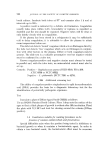
742 JOURNAL OF THE SOCIETY OF COSMETIC CHEMISTS 9. DEFINITIONS "Cosmetic or Toilet Preparations" are substances or preparations (i) intended to cleanse, beautify or modify the appearance of a person by external application to the skin, nails, hair, eyes or the oral cavity--but not intended to be swallowed or (ii) which exert a non-systemic action on or modification of local physiological functions so as to prevent, reduce or correct minor undesirable surface conditions, blemishes or defects of the skin, nails, hair, eyes or the oral cavity (but not intended to be swallowed) and are so sold. The following definitions apply to (i) and (ii):-- "Non-Systemic"--Localised in or upon the skin, its appendages, its local blood capillary network or its own nerve supply and not mediated through the general blood circulation or the central nervous system. "Minor"--Not requiring medical or dental diagnosis or treatment. Explanatory notes 4.4. To be read in conjunction with 3.1. It recognises the use of outside consultants and laboratories that are adequately equipped and staffed. 6.1. Should be interpreted in its broadest sense: "deleteriously reactive" includes the possibility of contamination from all ancillary equipment. 6.2. Indicates an overall standard for measurement. It recognises the possibility of varying specific gravities and recommends weight measure- ment wherever possible. 7.7. Shelf life, turnover time and company policy will dictate practical representation.

Appendix B This Appendix describes microbiological test procedures for use in product development and quality control, as well as giving detailed recommendations on preservatives. In order to produce a reasonably concise set of recommendations, it has been assumed that readers will have at least an elementary knowledge of microbiological laboratory technique. Whilst a fully-trained microbiologist should be thoroughly familiar with most of the contents of this and the following Appendices and may prefer various alternative procedures to those recommended here, the text has been prepared with a particular view to aiding the less experienced reader who is advised to follow the suggested techniques as closely as possible. 1. MICROBIOLOGICAL TEST PROCEDURES The information given below includes a selection of test media and conditions of incubation recommended for the isolation of microbial con- taminants commonly found in cosmetic products and raw materials or which would represent a serious hazard if they were present. The list of test media is not exhaustive nor is it suggested that the entire range of media needs to be used routinely. Inoculation of samples on or in the media designated as 1.311, 1.312, 1.314, 1.361 and 1.363 together with gram staining and study of the morphology of micro-organisms found, will provide basic information on the extent and type of microbial contamination affecting the preparation. References dealing with methods of identification are given in Appendix E. Samples showing growth in nutrient broth or by an agar streak method should be re-examined quantitatively. According to the present recommendations, bacterial counts are performed in duplicate in Oxoid Plate Count Agar. Cultures are incubated at 28-32 ø and 37 o and colonies counted after 48 h incubation. Mould counts are performed in malt extract agar or Sabouraud Dextrose Agar and incubated for five to seven days at 22-25 ø . Plates should be examined daily. New products, both at the formulation stage and with respect to the first large-scale batches, should be re-checked for micro-organisms after one month's storage at local ambient temperature. 1.1 Qualitative examination Methods of isolation and enumeration of micro-organisms usually require some form of special treatment of the samples to release into a fluid 743
Purchased for the exclusive use of nofirst nolast (unknown)
From: SCC Media Library & Resource Center (library.scconline.org)