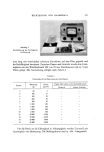
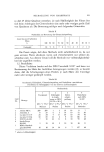
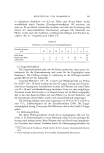
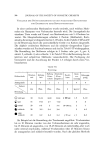
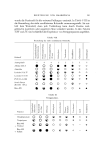
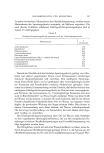
f. Soc. Cosmetic Chemists 22, 303-313 (1971) 01komponenten fifr Kosmetika Versuche zur experimentellen Bestimmung ihres Gebrauchswertes HERMANN KROKE* [/orgetragen am 8. Mai 1970 in GSttingen Synopsis--Oil Components in Cosmetics. Attempts to Determine Experimentally their Value for Practical Application. The value for practical application of oil components is not only determined by their greasing property. In developing improved raw materials or choosing optimal oils for the cosmetic industry, numerous application and physicochemical properties of the products have to be tested, too. Moreover, the raw materials have to be skin-compatible and non-toxic. With oil components, the spreading capacity on water and on the skin is of particular interest. Numerical values for the spreading on water are the equilibrium spreading pressure • (dyn/ cm) • = •I-I20 -- •oeilm, which can easily be measured according to the vertical plates method (Wilhelmy), and the spreading coefficient. The latter is calculated from the surface tensions of water and oil and the interfacial tension of HaO/oil as follows: $: 7I-I20 - (•'oil -•- 7H20/oil ) By combining the relations for the two numerical spreading values, the conditions necessary for a good spreading on water can be evaluated. Of the oils tested, oleyl alcohol was found to spread best on water, and isononanoic acid fatty alcohol ester to spread least well. No relations can be found between the spreading capacity on water and the polarity or emulsi- fying capacity of the compounds, respectively. The spreading of oils on the skin cannot be de- ducted from the spreading values on water. It can, however, be calculated from the surface ten- sion of the oils. Thus, the rather expensive determinations with test persons can be avoided. Table l: Compilation of the substances tested (alcohols, fatty acid esters from fatty alcohols, short-chained alcohols, and glycerin). Table II: Equilibrium spreading pressures of the oil components on water, measured according to the vertical plates method (Wilhelmy). Table III: Comparison between the equilibrium spreading pressures and the polarity values, cal- culated according to the method of the determination of the HLB value. * Laboratorien der Henkel & Cie GmbH, Diisseldorf 3O3

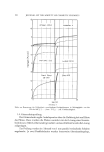
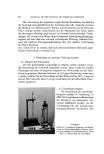
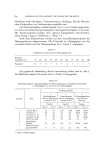
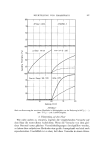
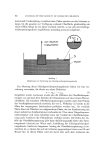
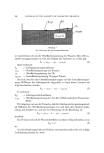
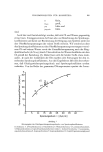
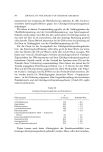
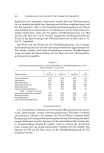
304 JOURNAL OF THE SOCIETY OF COSMETIC CHEMISTS TableIV: Comparison of the data obtained on the equilibrium spreading pressure zr, the spreading coefficient S, the surface tension 7, and the spreading capacity Y on the skin. Figure 1: Diagrammatic representation of the measuring principle for the determination of the equilibrium spreading pressure on water according to the Wilhelmy method. Figure 2: Schematized representation of the interfacial relations for the derivation of the spreading coefficient. Figure 3: Graphic comparison between the equilibrium spreading pressure and the spreading coefficient, illustrating the interdependence of the two quantities. Grundstoffe filr kosmetische Zubereitungen, wie Salben- und Puder- grundlagen, Emulgatoren, Ole und andere Fettstoffe, Parfilms, Farbstoffe und dergleichen, wetden den Herstellern von Kosmetika von der chemischen In- dusttie in groBer Auswahl zur Verfilgung gestellt. An diese Grundstoffe mils- sen hohe Anforderungen bezilglich Reinheit und dermatologischer Unbe- denklichkeit, abet auch in Hinsicht auf einfache Verarbeitbarkeit und geeig- nete physikalisch-chemische Beschaffenheit gestellt wetden. Im folgenden soil am Beispiel von Olkomponenten ein Einblick in die Untersuchungsme- thodik bei Entwicklungsarbeiten gegeben wetden. Dabei soil insbesondere gekl•irt wetden, inwieweit sich bei Olkomponenten dutch Ermittlung ihrer physikalisch-chemischen Eigenschaften - Gleichgewichtsspreitungsdruck, Spreitungskoeffizient, Oberfliichenspannung und Spreitverm6gen auf der Haut- direkte Rtickschlilsse auf die anwendungstechnischen Eigenschaften des Fertigprodukts ergeben. AnstoB filr solche gezielten Entwicklungsarbei- ten sind ver•inderte Verbrauchergewohnheiten, neuarfige Rezepturen oder neue Verbindungen mir spezifischen Eigenschaften aus den eigenen For- schungslaboratorien. Bei Olkomponenten haben wit strenge Kriterien erstelk, was Farbe, Ge- ruch und Reinheir angeht. Neben der LOslichkeit, insbesondere in Alkohol- Wasser-Mischungen, der Mischbarkeit mir anderen Olen, wird die Emulgier- barkelt geprtift. Emulgierbarkeit und auch Verarbeitbarkeit werden am ratio- hellsten dutch Einarbeitung in typische Rahmenrezepturen und deren Beur- teilung getester. Wenn sichergestellt ist, dab sich eine neue Olkomponente technisch filr be- stimmte Kosmetika eignet, so wetden zun&hst die erforderlichen dermatologi- schen und toxikologischen Daten ermittelt. Neben der Bestimmung der Gebrauchseigenschaften und der dermatologi- schen Vertriglichkeit wetden in vielen F•illen weitergehende physikalisch- chemische Untersuchungen der Einzelkomponenten durchgefilhrt, um so st•irkere Differenzierungen bezilglich der Anwendung erkennen zu kOnnen. Bei Olkomponenten interessiert z. B. das SpreitvermOgen, und zwar ein- mal auf Wasset, zum anderen auf der Haut. Das Spreitverm6gen auf Wasset
Purchased for the exclusive use of nofirst nolast (unknown)
From: SCC Media Library & Resource Center (library.scconline.org)