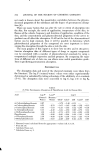
I. Soc. Cosmet. Chem., 24, 371-384 (May 23, 1973) Physicochemical Properties and Percutaneous Absorption of Drugs* ERIC J. LIEN, Ph.D., and GEORGE L. TONG, Pharm. D.* Presented May 25, 1972, Seminar Lo, Angeles, Calif. Synopsis-With the EXTRATHERMODYNAMIC APPROACH it was found that for many series of DRUGS, PERCUTANEOUS ABSORPTION through intact skin is highly dependent upon the lipophilic character as measured by log (partition coefficient) from octanol/water, ether/water, and other suitable solvent systems. This lends support to the "barrier effect" of the stratum corneum of the epidermis against penetration by sub- stances with inadequate lip old solubility. COMPUTERIZED MULTIPLE REGRESSION ANALYSIS showed that the addition of other steric or electronic terms, such as molar refraction, Taft's polar substituent constant (½*), molecular weight, and solubility in water, significantly improved the cor- relations in some cases. The approach used would enable a cosmetic chemist to predict the relative degree of drug absorption through skin from the PHYSICOCHEMICAL CONSTANTS of series of compounds and the absorption data of a few parent molecules. INTRODUCTION Since all cosmetic preparations are intended for local application, rapid ab- sorption of the active ingredients through the skin into blood circulation is, in many cases, undesirable. However, for some medicated preparations, such as creams containing hormones or vitamins and antiperspirant products, absorp- tion into the skin is necessary for achieving the desired beneficial effect locally. In any event, it is very important for a cosmetic chemist to be able to predict the extent to which a cosmetic material or drug will be absorbed through the skin or into the skin. As a matter of fact, the need for "quantitative measure of permeability" was clearly emphasized in a 1959 seminar ( 1 ). Several useful generalizations concerning the percutaneous absorption of different types of chemicals have been well documented (2, 3). Unfortunately, *This study was supported in part by General Research Support Grant 5 SO1 RR- 05702-02 from the General Research Support Branch, National Institutes of Health. tSchool of Pharmacy, University of Southern California, University Park, Los Angeles, Calif. 90007. Inquiries should be addressed to E. J. Lien. 371

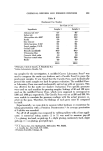
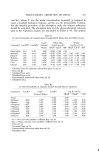
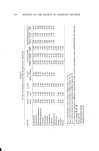
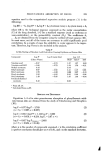
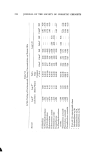
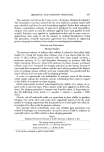
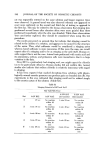
372 JOURNAL OF THE SOCIETY OF COSMETIC CHEMISTS not much is known about the quantitative correlation between the physieo- chemical properties of the substance and the degree of percutaneous absorp- tion (4). There are many factors that can alter the rate or extent of absorption into the skin. For example, the mode of application, temperature of the skin, in- fluence of the vehicle, frequency and duration of application, condition of the skin, and the concentration and physicochemical properties of the active in- gredient can all affect the absorption. If all but the last of the aforementioned factors can be kept constant, then it will be possible to determine which phsicochemical properties of the compound are most important in deter- mining the absorption through the skin or into the skin. The main purpose of this report is to show how in vitro and in situ percu- taneous absorption data of different types of drugs or organic compounds can be correlated with a number of physicochemical constants by using a computerized multiple regression analysis program. By comparing the equa- tions of different sets of data one can obtain some useful quantitative guide- lines in predicting percutaneous absorption. EXPERIMENTAL The absorption data and most of the chemical constants were taken from the literature. The log P (octanol/water) values were either experimentally determined or calculated by taking advantage of the additivity of rr constants (5-8). The absorption data were converted to log C, log 1/C or log K• Table I In Vitro Percutaneous Absorption of Phenylbornic Acids by Human Skin Acid Log P• Log pb Log C (Octanol/ (Benzene/ Water) Water) Obsd • Calcd c Diff Calcd a Diff m-Carbamidophenylboronic 0.57 . .. --3.73 --3.42 --0.31 ...... m-Carboxyphenylboronic 0.53 --2.53 --3.65 --3.45 --0.20 --3.52 --0.13 p-Carboxyphenylboronic 0.53 --1.83 --3.33 --3.45 0.12 --2.64 --0.10 m-Aminophenylboronic 0.43 --2.32 --3.24 --3.50 0.26 --2.a0 0.14 p-Methoxyphenylboronic 1.69 --0.43 --2.74 --2.78 0.04 --2.50 --0.09 Phenylboronic 1.58 --0.80 --2.66 --2 84 0.18 --3 43 0.19 p-Chloropheny]boronic 2 38 --0.09 --2.59 --2.38 --0.21 --3.23 --0.10 p-Methylpheny]boronic 2.06 --0.19 --2.45 --2.57 0.12 --2.54 0.09 P(octanol/water) calculated from the appropriate •- values (refs. 5, 6, 9). From ref. 10. Calculated from eq 1. Calculated from eq 3.
Purchased for the exclusive use of nofirst nolast (unknown)
From: SCC Media Library & Resource Center (library.scconline.org)