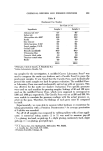
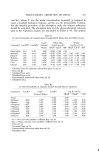
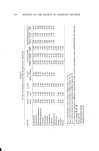
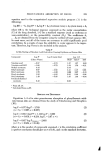
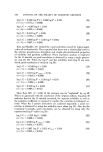
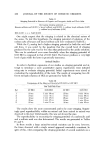
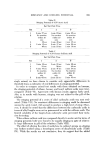
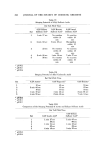
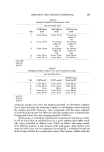
IRRITANCY AND STINGING POTENTIAL 391 Table IX Stinging Potential of Dicarboxylic Acids Rat Tail Flick Trine 0.3M Oxalic 0.3M Malonic 0.3M Succinic Rat Acid • Acid b Acid ø 1 5 tnin 56 sec 8 min 08 sec No reaction within 10 min 2 5 min 39 sec No reaction No reaction within 10 within 10 min min 3 6 tnin 19 sec No reaction No reaction within 10 within 10 min min 4 I tnin 02 sec 3 tnin 35 sec I tnin 59 sec 5 I tnin 07 sec 4 min 46 sec 5 min 27 sec • pH 1.25. b pH 2.0. c pH 2.4. Table X Stinging Potential of Mono-, Di-, and Tricarboxylic Acids Rat Tail Flick Titne 0.3M Propane Rat 0.3M Acetic • 0.3M Succinic • Tricarboxylic • 1 1 •nin 03 sec 1 •nin 31 sec 3 •nin 56 sec 2 2 •nin 26 sec 4 •nin 14 sec 8 •nin 45 sec 3 11 sec 22 sec 18 sec 4 3 min 01 sec 1 min 55 sec 3 min 09 sec 5 2 •nin 00 sec I min 15 sec 2 min 47 sec • pH 2.6. • pH 2.4. c pH 2.5. methylene groups may lower the stinging potential. An alternative explana- tion is that increasing the molecular weight in a homologous series decreases the stinging potential. However, when compounds with the same carboxyl- to-methylene group ratio but different molecular weights were evaluated, they all appeared to have the same stinging potential (Table X). At this point, a word about experiment-to-experiment variation is in order. It will be noted that rat tail flick times for a given solution often differ mark- edly when evaluated on different rats. While we believe this arises mainly from different degrees of tail abrasion with sand paper, other factors were observed which may also be important. Occasionally, a rat flicked its tail out of the testing solution for no particular reason. This became evident when the

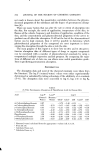
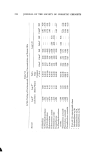
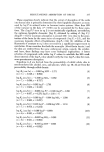
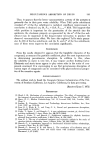
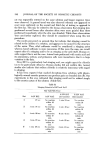
392 JOURNAL. OF THE SOCIETY OF COSMETIC CHEMISTS rat was repeatedly retested on the same solution and longer response times were observed. A general trend was also observed wherein rats appeared to react more uniformly on the second and third day of testing as opposed to the first day. This may be related to the human observation that stinging tests performed several hours after abrasion often were more painful than those performed immediately after the skin was abraded. While these observations were not further explored, they should be considered when using this test procedure. The results presented on animals thus far indicate that stinging cannot be related to the acidity of a solution, and appears to be caused by the structure of the anion. Thus, ethyl sulfonate would be considered a stinging anion whereas lauryl sulfonate is more innocuous. If this were the case, one would expect salts of a stinging acid to be as stinging as the acid itself. Human re- suits suggest this is not the case. Animal tests performed with acetic acid and its ammonium, sodium, and potassium salts were inconclusive due to a large variation in the data. Since HC1 is a particularly bad stinging acid, one might expect the chloride ion to be particularly offensive. Human studies did not confirm this. Animal studies also indicate that sodium chloride is relatively innocuous with regard to stinging. It has been reported that marked deviations from solutions with physio- logically normal osmotic pressures can produce pain on denuded skin (6). Our experiments in this area indicated that stinging could not be related simply to the osmotic nature of the solution (Table XI). Table XI Stinging Potential of HC1 and NaC1 Rat Tail Flick Time 0.15N HC1 0.15N NaC1 Rat 0.3N HC1 0.3N NaC1 (Iso-osmotic) (Iso-osmotic) I 27 sec No reaction 1 rain 51 sec No reaction within 10 w•thin 10 rain rain 2 1 rain 34 see No reaction 1 rain 48 sec No reaction within 10 within 10 rain lnin 3 4 rain 08 sec No reaction 6 min 42 sec No reaction within 10 within 10 rain rain 4 I min 07 sec No reaction i rain 25 sec No reaction within 10 within 10 min min 5 1 rain 20 see No reaction 3 min 10 see No reaction within 10 within 10 rain rain
Purchased for the exclusive use of nofirst nolast (unknown)
From: SCC Media Library & Resource Center (library.scconline.org)