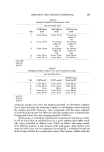
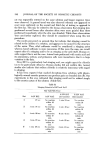
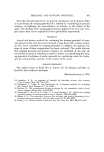
J. Soc. Cosmet. Chem., 24, 385-393 (May 23, 1973) Studies on Potential Irritancy and Stinging KARL LADEN, Ph.D.* Presented April 12, 1972, Symposium on Skin-Environmental Responses and Protection, Society o1' Cosmetic Chemists o1' Great Britain Synopsis-ANIMAL and HUMAN METHODS for evaluating the STINGING POTEN- TIAL of materials placed on the skin have been devised. Using these tests, various ma- terials have been evaluated for stinging potential. In addition, the primary IRRITANCY of some of these compositions has been evaluated. The results indicate that stinging potential and primary irritancy are unrelated. It was also observed that no general con- clusions could be drawn as to predicting the stinging potential of solutions of acidic materials by considering solely the hydrogen ion concentration, tonicity, or the nature of the anion. INTRODUCTION Testing of cosmetic formulations for their skin irritancy potential has long been recognized as one of the safety measures required prior to marketing. To this end, a large number of both animal and human testing procedures have been described in the literature. A comprehensive reviexv of these methods has recently been published ( 1 ). In spite of extensive testing of this nature, it has sometimes been observed in our laboratory that prototype formulations which have low primary irritancy cause discomfort to the user in terms of low levels of stinging. Furthermore, it seemed that the stinging potential of a formula- tion was often totally unrelated to its primary irritancy. The purpose of this work was to develop some useful methods for measuring stinging potential of formulations and to gain some insight into relating chemical composition to stinging potential. This communication presents some of our preliminary find- ings in this area. *Gillette Research Institute, 1413 Research Blvd., Rockville, Md. 20850. 385

386 JOURNAL OF THE SOCIETY OF COSMETIC CHEMISTS METHODS Irritancy Primary irritancy was evaluated in rats or guinea pigs using the procedure of Finkelstein et al. (2). Stinging Many experimental methods for measuring pain in humans and laboratory animals have been described (3). In general, all of the methods involve some quantitative procedur• for inflicting pain (e.g., heat, electrical, pressure). The test subiect must then respond in some manner when his pain threshold is reached. With animals, some of the methods that have been used include: (a) the observation of a twitch in the skin of an animal in response to heat (b) the "dancing" of mice on a hot plate or on electrical conducting wires and (c) the flicking of the tail by a rat when heat or pressure is applied to it. This last test method appeared ideally suited to our needs. Thus, the pain inflicting stimuli in our case would be various formulations. The pain thresh- old or stinging potential could then be measured as the length of time a rat could keep its tail in the formulation before flicking it out. A standard test procedure was devised as follows: 5 rats were selected for any one test, they were placed in restraining chambers, and their tafis were abraded with a mediumsgrade sandpaper. An attempt was made to abrade each tail to the same degree by regulating the number of strokes and pressure applied. After a wait of 1-2 hours after abrasion or preferably overnight, the tail of each rat was immersed in isotonic saline oeor i min. After a 5-min rest period the rat tail was immersed in a solution of 3N HC1 and the time for the rat to flick its tail out of the solution was measured. If the rat did not flick its tail in 2 min or less, the tail was reabraded and the testing started again. When the rat flicked its tail out of the solution, the tail was immersed in a beaker of isotonic saline where the acid was washed off for a period of 3 min. The rat was then considered ready for testing other solutions using the same procedure. The same 5 rats were used for 3 consecutive days and then another set of 5 was selected. ttuman stinging potential was evaluated using a modification of the proce- dure of Armstrong et al. (4). These authors produced a small cantharidin blister, separated the epidermis thus exposing the blister base, and applied various solutions to the area at intervals of 5-10 min, measuring pain inten- sity by having the subiects squeeze a pressure bulb which recorded a tracing on a moving drum to indicate intensity of pain. In our studies on skin, the forehrm was abraded by repeated stripping with Scotch tape until the moist- •ned glistening denuded epidermis no longer adhered to the tape. At least 1 hour after abrasion, a small quantity (0.1-0.2 cc) of the formulation to be tested was swabbed onto the iniured area.
Purchased for the exclusive use of nofirst nolast (unknown)
From: SCC Media Library & Resource Center (library.scconline.org)