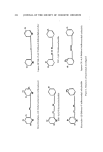
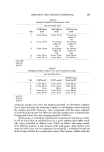
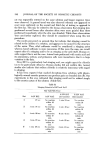
J. $oc. Cosmet. Chem., 24, 363-370 (May 23, 1973) Rapid Liquid Chromatography of Bacteriostats THOMAS WOLF, Ph.D., and DYMITRI SEMIONOW, B.A.* Presented October 9, 1972, Ioint Syml•osium of the Society of Cosmetic Chemis• and the Association of O•cial Analytical Chemists, Washington, D.C. Synopsis-High-pressure LIQUID CHROMATOGRAPHY has been applied in providing a fast, convenient method for separating and identifying BACTERIOSTATS in cosmetic preparations, such as toilet soaps. It is possible to separate up to four of the commonly used bacteriostats in one analysis, either by GRADIENT or STEP ELUTION techniques. Constant composition elution will separate no more than three, for example, 3,4,4'- trichlorocarbanilide (TCC), 3,4',5-tribromosalicylanilide (TBS), and hexachlorophene or 2',4,4'-trichloro-2-hydroxydiphenyl ether, 4,4'-dichloro-3-trifiuoromethyl carbanilide (CF•), and TBS. None of the techniques resolved CFs from TCC. Chromatography required 15 minutes and the limit of detection was 0.1/xg or better. ]'NTHODUCTION It is of considerable interest to have a fast, convenient method of separating and identifying bacteriostats. Analyses have been listed (1) that depend on ultraviolet spectroscopy, colorimetry, and polarography. However, these meth- ods are genera]ly not applicable to mixtures of bacteriostats. More recently several qualitative thin-layer separations have been described (1-4). Karles- kind et al. (5) have described quantitation following preparative tic, with an overall accuracy of about -4-_20%. This involves scraping the component streaks from tlc plates, which is an exacting and tedious task. It was thought that high-pressure liquid chromatography (HPLC) could provide an elegant qualitative and quantitative tool for bacteriostat analysis. The advantages sought from HPLC were direct quantitative response, short- ened time per analysis, greater sensitivity, and greater convenience. The bacteriostats tested are based on halogenated aromatic compounds and are thus ideally suited for measurement with a uv photometer detector. This note describes the qualitative aspects. *R & D Center, Colgate-Palmolive Co., Piscataway, N.J. 08854 363

364 JOURNAL OF THE SOCIETY OF COSMETIC CHEMISTS
Purchased for the exclusive use of nofirst nolast (unknown)
From: SCC Media Library & Resource Center (library.scconline.org)