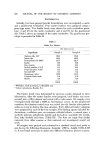
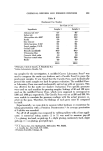
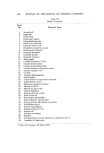
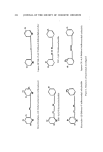
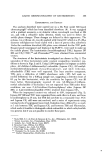
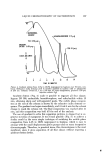
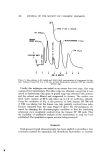
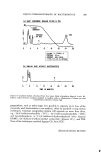
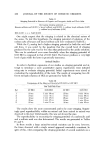
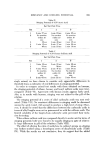
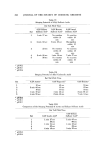
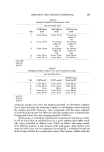
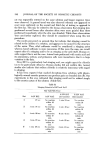
LIQUID CHROMATOGBAPHY OF BACTERIOSTATS 365 EXPERIMENTAL AND RESULTS The analyses described were carried out on a Du Pont model 820 liquid chromatograph* which has been described elsewhere (6). It was equipped with a gradient accessory, a uv detector whose wavelength was fixed at 254 nm, and with a refractive index detector, which was used to follow the mobile phase changes. These changes are delayed in their appearance. The column, 1 m x 3.0 mm i.d., was dry-packed with Corasil II* which is a 37-50-/• diameter solid-glass-core bead coated with a layer of porous silica adsorbent. Under the conditions described, 625 plates were obtained for the TCC peak. Reagent grade isopropanol and heptane,$ bp 98-99øC, were used to make up the mobile phases. The bacteriostats (hexachlorophene,õ TBS,] I Irgasans DP 300 and CFa,• TCC,** and Fluorosalan***) were obtained from commercial sources. The structures of the bacteriostats investigated are shown in Fig. 1. The separation of three bacteriostats under constant composition (isocratic) con- ditions is shown in Figs. 9, and 3. Using 11.0% isopropanol in heptane as mobile phase, 4,4'-dichloro-3-trifluoromethyl carbanilide (Irgasan CFa), 2,2'-methyl- enebis(3,4,6-trichlorophenol) (hexachlorophene), and 3,4',5 tribromo- salicylanilide (TBS) were well separated. The least sensitive component, TBS, gave a deflection of 0.0015 absorbance units (15% fidl scale re- corded deflection) for a 0.50-/zg sample size, suggesting a detection limit of 0.1 /zg for this bacteriostat, while the sensitivity for Irgasan CFa was 20 times better. Chromatography required 13 min. 3,5-Dibromo-3'-trifluoro- methyl salicylanilide (Fluorosalan) was not separated from TBS under these conditions, nor were 2',4,4'-trichloro-2-hydroxydiphenyl ether (Irgasan DP 300), or 3,4,4'-trichlorocarbanilide (TCC) resolved from Irgasan CFa. When the isopropanol content was reduced to 4.0%, isopropanol (Fig. 8), Irgasan DP 300 and TCC were separated from each other in 6 min, and from hexachlorophene in 18 min, but TBS did not elute in a reasonable time. TCC and Irgasan CFa still were not resolved, and a series of experiments using varying levels of isopropanol were tried. Retention times differed by as much as 1 min between TCC and Irgasan CFa and between TBS and Fluorosalan, which made it feasible to distinguish which carbanilide or which salicylanilide was present, but it was not possible to resolve these pairs. * Model 820, E. I. du Pont de Nemours & Co., Inc., Wilmington, Del. 19898. ? Waters Associates, Inc., Framingham, Mass. 01701. $ Analabs, Inc., North Haven, Conn. 06473. õ Givaudan Corp., Clifton, N.J. 07014. II Fine Organics, Inc., Lodi, N.J. 07644. •[ Ciba-Geigy Corp., Ardsley, N.Y. 10502. ** Monsanto Co., St. Louis, Mo. 63166. *** Stecker Chemical Inc., Ho-Ho-Kus, N.J. 07423.

366 JOURNAL OF THE SOCIETY OF COSMETIC CHEMISTS IRGASAN CF$ 0.05/.c õ HEXACHLO90.50/.c 0.001 A UNITS 0.50/-c9 I ,! , , • , , 0 2 4 6 8 I0 12 TIME IN MINUTES Figure 2. Isocratic elution. Mobile phase: 11.0% isopropanol in heptane column: Corasil II, 1 m x 3.0 ram, at room temperature {low rate: 1.1 ml/min at 150 psi uv photometer at 254 nm injection volume: 5/xl IRSASAN -- DP 500 0.8/.cõ -TCC 0.4/.cg •, 0.004 ABS UNITS HEXACHLOROPHENE :•.8/.ccJ TIME IN MINUTES Figure 3. Isocratic elution. Mobile phase: 4.0% isopropanol in heptane column: Corasil II, i m x 3.0 ram, at room temperature flow rate: 2.4 ml/min at 300 psi uv photometer at 254 nm injection volume: 5/zl
Purchased for the exclusive use of nofirst nolast (unknown)
From: SCC Media Library & Resource Center (library.scconline.org)