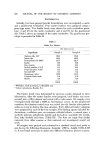
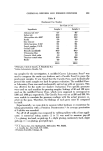
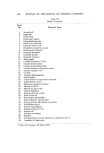
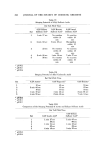
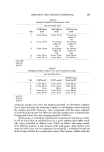
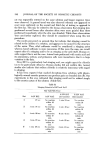
IRRITANCY AND STINGING POTENTIAL 393 From the data presented here, no general conclusions can be drawn, either as to predicting the stinging potential of a solution by considering its primary irritaney, its hydrogen ion concentration, its tonicity, or the nature of the anion. The etiology of the stinging phenomenon appears to be of a more com- plex nature than can be explained by these preliminary experiments. SUMMARY Animal and human methods for evaluating the stinging potential of mate- rials placed on the skin have been devised. Using these tests, various materi- als have been evaluated for stinging potential. In addition, the primary irri- tancy of some of these compositions has been evaluated. The results indicate that stinging potential and primary irritancy are unrelated. It was also ob- served that no general conclusions could be drawn as to predicting the sting- ing potential of solutions of acidic materials by considering solely the hydro- gen ion concentration, tonicity, or the nature of the anion. ACKNOWLEDGEMENT The author wishes to thank Mrs. J. Carver, Mr. M. Monaco and Mrs. C. Quirk for their technical assistance. (Received January 5, 1973) (1) Lansdown, A. B., An appraisal of inethods for detecting primary skin irritants, ]. Soc. Cosmet. Chem., 23, 739 (1972). (2) Finkelstein, P., Laden, K., and Miecho•vski, W., Laboratory methods for evaluating skin, Toxicol. Appl. Pharmacol., 7, 74 (1965). (3) Beechef, H., The measurement of pain, prototype for the quantitative study of sub- jective responses, Pharm. Rev., 9, 59 (1957). (4) Armstrong, D., Dry, R. M. L., Keele, C. A., and Markahm, J. W., Method for studying chemical exatants of cutaneous pain in man, ]. Physiol., 115, 59P (1951). (5) Blohm, S. G., The connection between skin irritating and protein denaturing effcct• of some surface-active agents, Acta Dermato-Venereol., 37, 269 (1957). (6) Keele, C. A., Chemical causes of pain and itch, Proc. Roy. Soc. Med., 50, 477 (I 957).

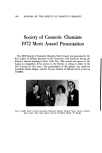
394 JOURNAL OF THE SOCIETY OF COSMETIC CHEMISTS Society of Cosmetic Chemists 1972 Merit Award Presentation The 1972 Society of Cosmetic Chemists Merit Award was presented to Dr. Karl Laden of Gillette Research at the December 12th luncheon during the Society's annual meeting in New York City. The award was given to Dr. Laden in recognition of his service to the Society in acting as editor of the SCC Journal for five years. The presentation of the plaque was made by President Martin Rieger, and Dr. Hyman Henkin of Helene Curtis served as Eulogist. Left to right: Merit Award Committee Chairman Hyman Henkin, Merit Award recipient Karl Laden, Mrs. Karl Laden, Society President Martin M. Rieger
Purchased for the exclusive use of nofirst nolast (unknown)
From: SCC Media Library & Resource Center (library.scconline.org)