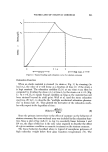
250 JOURNAL OF THE SOCIETY OF COSMETIC CHEMISTS 0.9 0.8 0.7 0.6 0.5 0.4 0.3 0.2 0.'1 0 lO 20 30 40 50 60 70 80 90 100 Relative Humidity ([) Figure 6. Transepidermal water loss vs. relative humidity * * * Goodman and Wolf (15) -•-•-•- Criee et al. (2) --0--0--0-- present paper Thus it is possible to plot log J against•-(Fig. 7) and compute Ev. The value for Ev for fully hydrated stratum codneum cited by Scheuplein and Blank (21) is 13-16 kcal mole -x. The clearly expotential temperature dependence of water vapor permeability is proof of transmission by diffusion. Transmission by ran- dom kinetic motion through a capillary would be expected to be proportional to T v' (22). A more comprehensive discussion ,of the factors involved in diffu- sion of water through stratum corneum has been given by Berube and Ber- dick ( 23 ). CONCLUSIONS 1. The mechanical properties of human stratum cornturn, as measured by the elastic modulus or by stress relaxation, are dependent on the moisture content of the stratum corncure.

WATER LOSS OF STRATUM CORNEUM 251 ] o0 m 0o5 m 32O ! y x l0 s (deg -!) Figure 7. Water permeation through stratum comeurn as a function of temperature •. The rate o• water vapor absorption o• human stratum corneum depends on the relative humidity. The equilibrium water content o• extracted and nn- extracted human stratum corneum at humidities below about 80% is essential- ly the same. 3. The rate of water vapor transmission through human stratum corneum in vitro is a linear function of the ambient relative humidity. Th•s rate is markedly decreased by a reduction in temperature. ( Received November 13, 1973 )
Purchased for the exclusive use of nofirst nolast (unknown)
From: SCC Media Library & Resource Center (library.scconline.org)