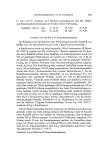
244 JOURNAL OF THE SOCIETY OF COSMETIC CHEMISTS Humidity Control In order to obtain dry air (0% RH), the air was first passed through re- agent grade sulfuric acid and then magnesium perchlorate* since it has been reported that calcium chloride will permit passage of up to 160 ppm of water in a gas stream (10). In experiments in which constant humidity solutions were used, the saturated solutions of several salts were employed ( 11 ). When an air stream of constant humidity was required for several days, the use of saturated salt solutions is inconvenient due to blockage of the gas dispersion tube by crystallization. Therefore, the apparatus described by Smith (12) was used. This apparatus consists of a proportioning valve and saturators to mix controlled quantities of wet and dry air to obtain a given humidity. The equipment is capable of accurately supplying air at any RH between 0 and 100% in 5% RH steps over a wide range of temperatures. Materials Unless otherwise indicated, C.P. reagents were employed throughout. Post- mortem abdominal skin was immediately frozen in dry ice. Within 72 hours, the samples were heated in a water bath to 52 ø ñ 2øC, and the stratum cor- neum was peeled from the dermis as described by Kligman and Christoph- ers (13). The separated stratum corneum was washed in several changes of distilled water and gently picked up on a piece of stainless steel wire mesh. The stratum corneum was air-dried, removed from the screen, and stored over magnesium perchlorate. When extracted stratum corneum was required, it was extracted according to the procedure of Blank (14), i.e., 24 hours in pyridine at room temperature followed by 1-hour extraction with water at room temperature. •{ESULTS AND DISCUSSION Mechanical Properties In order to avoid experimental artifacts and to conserve material it was de- cided to determine whether the stratum corneum is elastically isotropic or anisotropic like the dermis. The values of the quantity AxE for stratum cor- neum extended under water at room temperature were 1.79 - 0.12 x 10 4 dynes and 1.90 ñ 0.18 x 10⁴ dynes, respectively, for strips (8 in each direction) cut at right angles to each other. The results indicate that the stratum corneum may be considered isotropic. Adjacent strips of stratum corneum usually have AxE values within +- 5% but occasionally vary by as much as 30-40% As expected, the elastic modulus of human stratum corneum was found to be a function of the ambient RH. The results of Fig. 3 confirm those of many other investigators and show that stratum corneum becomes "softer" when *Anhydrone©, I. T. Baker Chemical Co., Philadelphia, N.J.

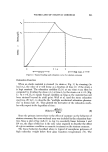
WATER LOSS OF STRATUM CORNEUM 245 13 12 ll l0 1 o lO 20 30 40 50 60 70 80 90 lOO Percent Relative Humidity Figure 3. Elastic modulus of stratum corneum as a function of relative humidity (vertical bars refer to average deviation) the RH increases. The average deviations noted in these experiments are quite high. In fact, the large deviation at 15% RH suggests that relatively dry stratum corneum cannot respond as a homogeneous material. Goodman and Wolf (15) also have noted large standard deviations of in vivo water trans- mission data at ]ow RH's. At higher RH's, the higher moisture content tends to make the stratum corneum act in a more homogeneous way, thus lowering the average deviation. The relationship between modulus and RH has been presented in linear form, although Parks and Baddiel (16) have indicated that this relationship is nonlinear above 60% RH. It is noted in passing that different specimens of stratum corneum yield "lines" having different slopes.
Purchased for the exclusive use of nofirst nolast (unknown)
From: SCC Media Library & Resource Center (library.scconline.org)