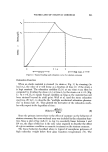
246 JOURNAL OF THE SOCIETY OF COSMETIC CHEMISTS 1.0 0.9 0.8 0.3 0.2 1 2 3 Log t (sec.) Figure 4. Stress relaxation o• stratum eorneum (log plot o• AxE• rs. t). Values o• AxEr at any time are divided by AxEr at time zero ß = 0% RH ,• 76% BH } = 31% RH X= 100% BH The stress relaxation experiments were conducted on samples of stratum comeurn in humidified air. In preliminary experiments, it was found that for strains between 0.01 and 0.10 the relaxation spectra were essentially identical. Therefore, the samples were stressed to a constant stress (4.0 g) rather than a constant strain, since stress is instrumentally more easily controlled. At the start it was necessary to demonstrate that the slopes of the lines re- sulting from a plot of log AxE• vs. log t depend on the humidity of the air. Figure 4 shows that the plots are linear and that their slopes are functions of humidity. It is possible to estimate the errors of the slopes by comparing the slopes resuIting from stress relaxation experiments on adlacent pieces of stra- tum corneum at the same RH. These errors are compared to those obtained by

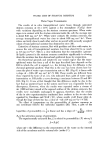
247 WATER LOSS OF STRATUM CORNEUM Table I Average Deviation of Mechanical Measurements AxE % RH Value Av. Der. Value Av. Der. Slope [H(lnr)] 100 (4) ø 215 _+ 35 -0.173 +__0.039 76 (4) 280 ___ 29 -0.164 _+0.031 31 (5) 393 ___100 -0.0938 +__0.004 0 (4) 534 +__121 -0.052'8 ___0.002 •Figure in parentheses refers to number of samples tested at each RH. merely determining the value of AxE for adjacent pieces of stratum corneum at the same RH (Fig. 3). This comparison, shown in Table I, indicates that AxE values are most precise at high RH, while the slope of the stress relaxa- tion function is most precise at low RH's. Accordingly, the stress relaxation function is the preferred measurement under relatively dry conditions. Water Absorption The rate of water absorption by strips of unextracted stratum corneum dried over concentrated H2SO4 and then exposed to different RH's is shown in Fig. 5. In agreement with other investigators, the rate of regain was found to be dependent on RH and on the presence of "natural moisturizers." In the examples studied here at high RH (93%), the difference in absorption rates up to about 30 rain between the extracted and unextracted stratum corneum is unexpectedly low. Most investigators who have studied the differences in moisture absorption of extracted and unextracted "keratinized" tissue record equilibrium moisture absorption. Singer and Vinson (17) record equilibrium moisture contents (at 80% RH) for normal neonatal rat corneum and callus of about 50% and of about 20-30% after solvent + H20 extraction. The equi- librium moisture contents at RH's up to 80% obtained in this study of unex- tracted human stratum comeurn are much lower and are only marginally dependent on extraction (with pyridine and water). The results are re- corded in Table II and were so unexpevted that the problem was studied on three specimens of stratum corneum. In all cases, the moisture absorption was determined on a small piece of stratum corneum and was then rede- termined on the identical piece after extraction. The weight loss due to ex- traction generally ranged between 25 and 30%. It is not possible to offer a definitive explanation for the discrepancy of the data obtained here and those reported by other investigators (14). It is noted that the data of Fox et al. (18) are close to those found here, and that the significant differences be- tween extracted and unextracted cornified epithelial tissue observed by other investigators occur at RH's 80%. Such high humidities were usually avoided here because it was difficult to maintain high humidities for the long periods required for equilibration (up to 8-10 hours) at ambient tempera- ture without condensation.
Purchased for the exclusive use of nofirst nolast (unknown)
From: SCC Media Library & Resource Center (library.scconline.org)