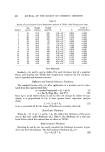
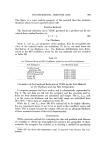
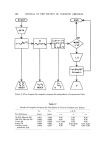
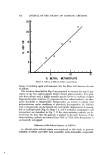
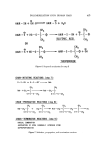
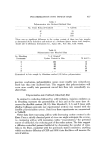
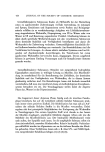
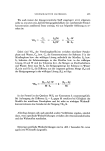
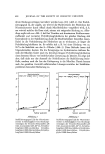
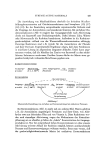
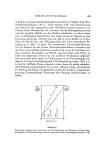
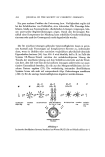
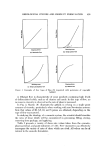
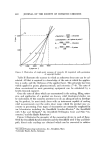
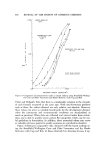
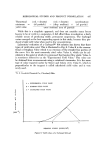
414 JOURNAL OF THE SOCIETY OF COSMETIC CHEMISTS 25 2O 15- I0- 5- 0 o / I I I I I õ % METHYL METHACRYLATE Figure 5. Add-on at different MMA concentrations I I , I fusion of oxidizing agent and monomer into the fibers will decrease the rate of add-on. The reactions described in Fig. 6 are proposed to account for step 5, gen- eration of the free radical species which initiates polymerization. It is prob- able that sulfenic acid, a highly unstable species known to undergo complex disproportionation reactions (7), generates the free radical initiator. An alter- native possibility is thioperoxide. Thioperoxides are known to initiate vinyl polymerizations under conditions of photolyric decomposition (8). Sulfenic acid or thioperoxide can be formed v/a nucleophilic displacement of ruercap- tide on hydroperoxide (Fig. 6). Steps 7, 8, and 9 (initiation, propagation, and termination) are described in Fig. 7. If the chain-initiating radicals are de- rived from the hair, then the polymer is grafted to the hair however, if the chain-initiating radicals are formed from CHP or TGA, then the polymer is mechanically entrappeal. Influence ol • the Solvent System on Add-On An ethanol-water solvent system was employed in this study to promote solubility of MMA and CHP, both essentially water-immiscible compounds.

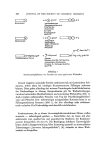
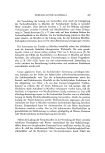
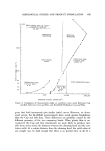
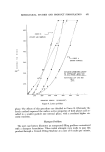
POLYMERIZATION INTO HUMAN HAIR HAIR- SH -!- OH •- HAIR - S -r- H20 CH 3 e i HAIR - S -!- HO - 0 - C - • I CH3 OR HAIR - S -!- HO-0-C-• I CH• HAIR --S - OR -!- 0 - C - I SULFENIC ACID CH:• •H• e HAIR- S- O-C- (• -i- OH I CH3 THIOPEROXIDE Figure 6. Proposed mechanism for step 5 CHAIN-INITIATING REACTIONS { step 7}: R-S-OH or R-S--OR' • Rod. •H5 •H 3 Rod. + CH2--'C ---• Red--CH2--C. I I O--C--O-CH3 O=C--O--CH 3 CHAIN - PROPAGATION REACTIONS ( step 8): •H.• CiH 3 CiH • Red-CH2-C I ß -'t- CH2---- C • Red -- CH2--C I • CH 2 I O=C-O-CH 5 O----C-O-CH• O:C-O-CH• H• C.-•--*--elc. I O---C--CH• CHAIN-TERMINATION REACTIONS {step 9]: RADICAL COMBINATION ABSTRACTION OF ATOM (GENERALLY HYDROGEN ATOM) DISPROPORTIONATION Figure 7. Initiation, propogation, and termination reactions
Purchased for the exclusive use of nofirst nolast (unknown)
From: SCC Media Library & Resource Center (library.scconline.org)