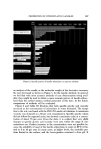
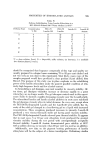
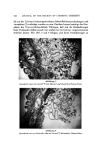
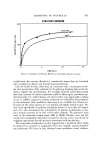
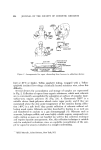
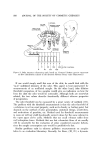
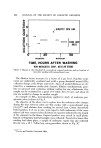
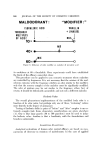
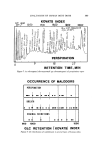
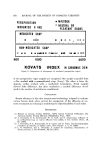
570 JOURNAL OF THE SOCIETY OF COSMETIC CHEMISTS PERSPIRATION ß MALODQR' • o NEUTRAL OR INCUBATED 8 HRS PLEASANT ODORS MEDICATED SDAP ß 0003 ß ß 0 0 i, , , I I f I ,I I I I I oo 0 51 NON-MEDICATED SOAP 0 ß • ß ß •• ß 0•00(::) I I I I I I i )o lOOO o 000 2000 KOVATS INDEX IN CARBOWAX 20M Figure 9. Comparison of odorograms of incubated perspiration vapors of two perspiration vapor samples are compared. One sample is pooled from ax'llae washed with a nonmedicated soap (Ivory). The other is from the opposite axillae washed with a medicated formulation. Fresh samples showed little difference, but after incubation a marked difference devel- oped in the number of malodorous constituents. CONCLUSION Recent advances in the odor measurement technology, adapted to evaluate various human body odors, permit the comparison of the efilcacies of cos- metic treatments in reducing or modifying the objectionability of such odors. REFERENCES (1) Manual on Sensory Testing Methods, ASTM Special Technical Publication 434, American Society Testing Materials, Philadelphia, Penn., 1968. (2) A. Dravnieks, B. K. Krotoszynski, W. E. Lieb, and E. Jungermann, Influence of an antibacterial soap on various effluents from axillae, J. Soc. Cosmet. Chem., 19, 611 (1968). (3) A. Dravnieks, B. K. Krotoszynski, R. E. Casely, and D. TabeL Cas-ehromatographie evaluation of intensity of axillary odors, TGA Cosmet. ]., 1, 14 (19•69). (4) I. H. Distelheim, and A. Dravnieks, A method for separating characteristics of disease processes, ]. Int. Derma,tol., 19,, 241 (1973).

EVALUATION OF HUMAN BODY ODOR 571 (5) A, Dravnieks, B. K. Krotoszynski, L. Keith, and I. M. Bush, Odor threshold and gas-chromatographic assays of vaginal odors: changes with nitrofurazone treatment, J. Pharm. Sci., 59, 495 (1970). (6) A. Dravnieks, L. Keith, B. K. Krotoszynski, and ]. Shah, ¾aginal odors: GLC as- say method for evaluating odor changes, J. Pharm. Sci., 63, 36 (1974). (7) A. Dravnieks, Odors as signatures, New Scientist, 31, 622 (1966). (8) A. Dravnieks, B. K. KrGtoszynski, J. Whitfield, A. O'Donne]l, and T. Burgwald, High-speed collection of organic vapors from atmosphere, Environ. Sci. Technol., 5, 1220 (1971). (9) ASHRAE Handbook of Fundamentals, American Society of Heating and Refrigerat- ing Air Conditioning Engineers, New York, N.Y., 1972, p. 188. (10) T. Lindvail, Methods for measuring and evaluating odorous air pollution at the source and in the ambient air, Nord. Hyg. Tidskr., 51 (1970). (11) A. Dravnieks, Odor perception and odorous air pollution, Tappi, 55, 737 (1972). (12) S.S. Stevens, On the psyehophysieal law, Psychol. Rev., 64, 153 (1957). (13) S.S. Stevens, The surprising simplicity of sensory metrics, Amer. Ps[lchol., 17, 29 (1902). (14) T. Engen, Psychophysical scaling of odor intensity and quality, Ann. NY Acad. Sci., 116, 504 (1964). (15) Odors: evaluation, utilization, and control, Ann. NY Acad. Sci., 237 (1974). (16) S. H. Katz and E. J. Talbert, Intensities of odors and irritating effects of warning agents for inflammable and poisonous gases, U.S. Department of Commerce, Bureau of Mines, Technical Paper 480 (1930) cf. (11). (17) Tentative Standard Method for Referencing Odor Suprathreshold Intensity, Task Group E 18.04.02, American Society of Testing Materials, Philadelphia, Pa. (1975). (18) H. R. Moskowitz, A. Dravnieks, W. S. Cain, and A. Turk, Standardized procedure for expressing odor intensity, Chem. Senses Flavor, 1, 235 (1974). (19) A. Dravnieks, Measuring industrial odors, Chem. Eng. (Deskbook Issue), 91 (1974). (20) A. Dravnieks and W. H. Prokop, Source emission odor measurement by a dynamic forced-choice triangle olfactometer, J. Air Pollut. Contr. Assoc., 25, 28-35 (1975). (21) A. Dravnieks, W. R. t3oehme, and W. H. Prokop, Measurement of ambien! odors using dynamic forced-choice triangle olfectometer, in press. (22) A. Turk, Expressions of gaseous concentration and dilution ratios, Atto. Environ., 7, 967 (1973). (23) M. A. Amerine, R. M. Pangborn, and E. B. Roessler, Principles of Sensory Eval- uation of Food, Academic Press, New York, N.Y., 1965. (24) R. Harper, D. G. Land, N.M. Gri•ths, and E. C. Bate-Smith, Odour qualities: a glossary of usage, Brit. J. Psychol., 59, 231 (1968). (25) K. B. D6ving, Analysis of odour similarities from electrophysiological data, Acta Physiol. Scan., 68, 404 (1966). (26) E. Se]ke, W. K. Rohwedder, and H. J. Dutton, A micromethod to generate and col- lect odor constituents from heated cooking offs, J. Amer. Oil Chem. Soc., 49, 636 (1972). (27) G. H. Fuller, R. Ste]tenkamp, and G. A. Tisserand, The gas chromatograph with human sensor: perruiner model, Ann. NY Acad. Sci., 116, 711 (1964). (28) A. Dravnieks, and A. O'Donnell, Principles and some techniques of high-resolution headspace analysis, J. Agr. Food Chem., 19, 1049 (1971).
Purchased for the exclusive use of nofirst nolast (unknown)
From: SCC Media Library & Resource Center (library.scconline.org)