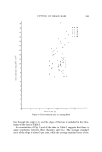
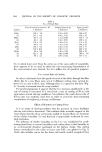
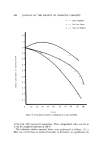
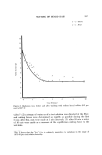
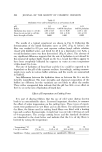
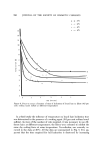
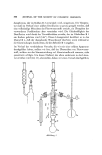
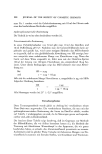
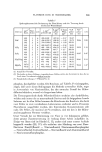
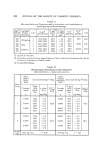
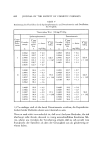
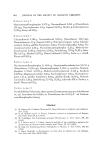
588 JOURNAL OF THE SOCIETY OF COSMETIC CHEMISTS Table II Hydration Time and Cutting Force as a Function of pH pH 9.1 6.84 4.01 Buffer 0.01 M borax 0.05 M phosphate 0.05 M phthalate Hydration time (rain) ñ std dev. 2.60 ___ 0.47 2.13 ñ 0.26 2.16 ñ_ 1.21 Force to cut wet (g) 4- std dev. 4.01 ñ 0.40 3.91 ñ 0.39 4.31 4- 0.31 Ionic Strength of buffer 0.060 0.091 0.053 The results of a typical experiment are shown in Fig. 6. Fo.llowing the determination of the initial hydration curve at 23øC (Fig. 6, before), the fiber was washed in 0.5 per cent aqueous sodium lauryl sulfate solution, rinsed with distilled water, and dried for 48 h in a desiccator over P205 a sccond hvdration curve was then detcrmincd (Fig. 6, aftcr). The absence of any significant difference suggests that the rate of hydration is not altered bv the removal of surface lipids. Based on the f-t-c, beard hair fibers appear to have been completely hydrated by exposure to water at room temperature within about 2 to 3 min. The rate of hydrarich of beard hair and the f-t-c could be expected to be dependent on the pH of the aqueous medium. Accordingly, cutting measure- ments were made in various buffer solutions, and the results are summarized in Table II. Any differences between the hydration times or between the f-t-c are sta- tistically insignificant. The ionic strengths and chemical composition of the buffers are different, but the variations are not likely to affect the results. These rather unexpected data indicate that the pH has little or no effect on the f-t-c or on the rate of hydration of beard hair. Effect of Temperature on Cutting Force It is part of shaving folklore that the use of cold water during shaving leads to an uncomfortable shave. It seemed important, therefore, to measure the effect of water temperature on the cutting force. Three types of experi- ments were performed on wet fibers and on dry fibers. For measurements on dry fibers, the fixture used for cutting beard fibers was fitted with a heating tape and a surface thermocouple. A single hair was cut (dry) 10 times at each of 4 temperatures. The average cutting forces and the standard deviations are tabulated in the chart below and indicate that the f-t-c of dry fibers is lowered by raising the temperature. Temperature (o C) 23 56 65 75 f-t-c (g) ñ std dev. 17.6 ñ 1.5 14.5 4- 1.3 12.3 ñ 0.80 13.1 ñ 0.84 Significance (Values connected by underlining are significantly different) _

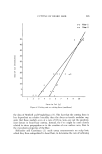
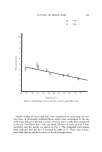
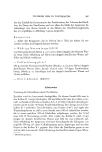
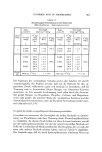
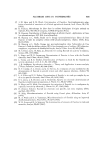
CUTTING OF BEARD HAIR 589 (•) -- Fiber 1 (•) - Fiber 2 10 0 20 25 30 35 40 45 50 55 60 65 70 Temperature o C Figure 7. Temperature (oC) vs. force to cut (g) on same fiber (wet) Si•nilar studies of wet beard hair were conducted by measuring the cut- ting force of thoroughly hydrated fibers which ,vere maintained at the de- sired temperature by playing a stream of warm water on the fiber positioned in the jig. Two fibers were each cut about 10 times at each of 4 or 5 tem- peratures, and the results are shown in Fig. 7. The computed least square slope indicates that the f-t-c is lowered by 0.051 g/øC. These data demon- strate that shaving should be easier at elevated temperatures.
Purchased for the exclusive use of nofirst nolast (unknown)
From: SCC Media Library & Resource Center (library.scconline.org)