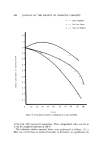
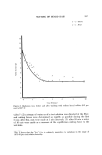
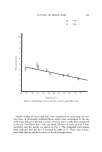
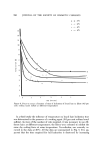
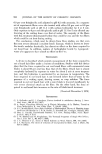
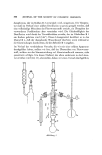
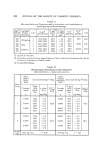
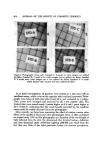
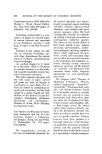
590 JOURNAL OF THE SOCIETY OF COSMETIC CHEMISTS • 7 x ß x-x j-j 40øC o - o 55•C x ß ! ß x o o 1 2 3 4 5 Time (Minutes) Figure 8. Force to cut as a function of time of hydration of beard hair in dilute (0.5 per cent) sodium ]auryl sulfate at different temperattires In a third study the influence of temperature on beard hair hydration time was determined in the presence of a wetting agent (0.5 per cent sodium lauryl sulfate). In view of the number of cuts required, it was necessary to use dif- ferent hairs at different temperatures the fibers were selected to exhibit the same dry cutting force at room temperature. Nevertheless, one anomaly oc- curred in the data at 30øC. All the data are summarized in Fig. 8. It is ap- parent that the time required for full hydration is shortened by increasing

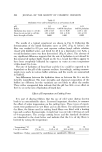
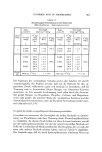
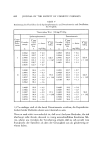
CUTTING OF BEARD HAIR 591 the temperature. Again (see Fig. 6), the f-t-c completely hydrated fibers de- creases as the temperature is raised. Effect of Chemical Treatments The results of the studies reported so far indicate that the rate of hydra- tion of beard hair is relatively fast and that softening-as measured by f-t-c- is not significantly altered by modest changes in pH or the presence of a wetting agent. In view of this, the effect of potassimn stearate solution, aero- sol shaving cream concentrates, and several finished commercial creams on the f-t-c hair was determined. None of these materials showed any reduction of the hydration time or of the f-t-c the fiber beyond that effected by water. Therefore, it was decided to utilize a few more drastic chemical treatments. Since 1-propanol/water mixtures are known to make hair easier to extend (6) a 45:55 (w/w) 1-propanol/water mixture was directed on the fiber during cutting. The data given in the chart below show that the difference betxveen the wet and dry cutting force (47 per cent lowering) is about the same as that of samples treated with distilled water (51 per cent lowering). The hydration time is comparable to that of water-treated fibers. Dry Wet (propanol/water) Average f-t-c (g) ___ std dev. 6.20 ñ 1.40 3.27 ___ 0.82 Hydration times (rain) __+ std dev. -- 2.76 q- 1.44 In a more drastic procedure, beard fibers of known wet f-t-c were soaked in a commercial waving lotion (6.0 per cent thioglycolic acid, pH 9.3) for 5, 7, and 10 min, rinsed in several changes of distilled water, and then cut under a stream of water. The results tabulated in the chart below confirm again that significant chemical attack (7 min in wavir•g lotion) on the fiber causes only a rain.or (13 per cent) reduction in the cutting force (98 per cent confidence level). Fibers exposed to the waving lotion for 10 min could not be cut because of excessive damage to the fiber, which allowed it to bend and to be split axially. Time of Waving Lotion Treatment f-be q- Std Dev. (in g) Control Treated 5 rain 3.95 ___ 1.06 4.20 ___ 0.65 7 min 5.20 ___ 0.57 4.51 ___ 0.54 McLaren (7) has shown that wool is reduced more drastically in thiogly- colic acid in aqueous 1-propanol (45:55 w/w) than aqueous thioglycolate. Therefore, it was decided to measure the cutting force of fibers soaked (for 2 or 5 rain) in 1-propanol/water (45:55) containing either 0.5 per cent or
Purchased for the exclusive use of nofirst nolast (unknown)
From: SCC Media Library & Resource Center (library.scconline.org)