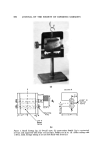
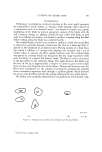
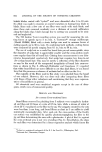
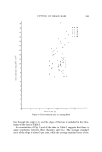
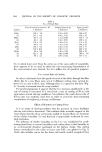
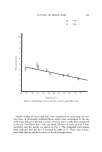
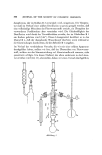
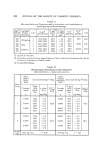
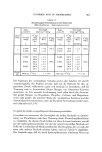
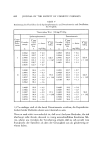
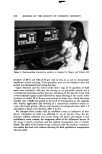
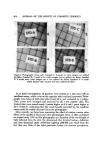
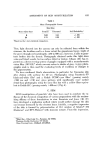
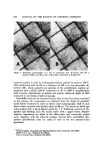
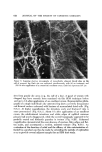
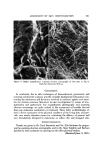
589. JOURNAL OF THE SOCIETY OF COSMETIC CHEMISTS Schick :blades coated with Vydax©* and were discarded after 5 to 10 cuts. No effort was made to examine or control variations in honing from blade to blade. Since only a few cuts of one fiber were made with each blade, and since these cuts occurred randomly over a distance of several millimeters along the blade edge, blade damage due to cutting was assumed to be mini- mal and neglected. The TM Instron Tester recording system was used for measuring the cut- ting forces at speeds up to 5 in./min. A Tectronix©* storage oxcilloscope (Model RM564) fitted with a strain bridge was used to measure forces at cutting speeds up to 50 in./min. By combining both methods, cutting forces were measured at speeds ranging from 0.1 in./min to 50 in./min. The use of scalp hair as a model for beard hair proved unacceptable, since the diameter of scalp hair is appreciably smaller and the cross-section much more regular than that of beard hair. Cutting force measurements in our labo- ratories demonstrated conclusively that scalp hair requires less force-to-cut (f-t-c) than beard hair. This may be merely a reflection of the fiber diameter or may be the result of the unexpected irregularity ,of beard hair cross-sec- tions as shoavn in Fig. 2. Although Hollander and Casselman (1) reported that white beard fibers are more difficult to cut than dark fibers, it was found here that the presence or absence of melanin had no effect on the f-t-c. The majority of the fibers used in this study were plucked from the beard of one subject. However, this was done only after comparing these fibers with those of four other volunteers and ascertaining that they were represen- tative of beard fibers in general. All chemicals used were analytical reagents except in the case of deter- gents, which were of commercial quality. PtESULTS AND DISCUSSION f-t-c versus Cross-sectional Area Beard fibers removed by plucking from 5 subjects were completely hydrat- ed and then cut 10 times at a rate of 0.5 in./min, while a stream of water at about 25øC was played on the fiber in the jig. The snippets created by the cuts were less than 1 mm long, and beard fibers as short as 3 cm suffice to yield statistically meaningful data. After each cut, the cross-section of the freshly cut surface was established by quickly photomicrographing the fiber in the jig and then determining the area with a planimeter. A plot of the f-t-c against the cross-sectional area is not very revealing (Fig. 3). Nevertheless, the slope for each fiber was determined by a linear regression analysis which forces the *Vydax is a registered trademark of the E. I. du Pont Co., Wilmington, Del. tTectronix Inc., Beaverton, Oregon.

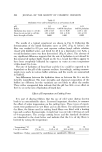
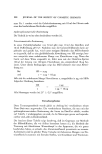
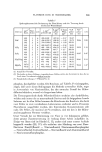
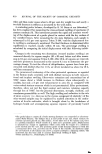
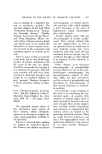
CUTTING OF BEARD HAIR 583 19 18 17 16 15 14 13 12 11 10 0 1 o o o o A . A oA X o x o x x A ß Aß A X ß ß A X A AA X X X A 0 A ß ß RR x x JL * o o JM * * JS o A ADD * o O 2 3 4 5 Force to Cut (g) Figure 3. Cross-sectional area rs. cutting force line through the origin (4), and the slope of this line is included in the tabu- lation of the data in Table I. An examination of Fig. 3 and of the data in Table I suggests that there is some correlation between fiber diameter and f-t-c. The average standard error of the slope is about 5 per cent, while the a,•rage standard error of the
Purchased for the exclusive use of nofirst nolast (unknown)
From: SCC Media Library & Resource Center (library.scconline.org)