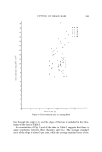
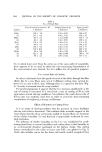
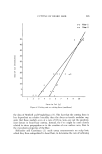
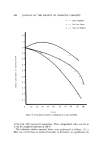
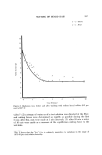
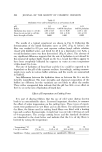
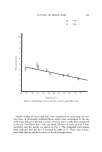
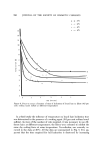
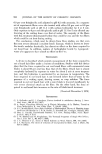
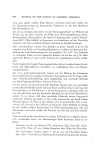
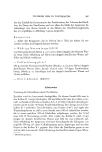
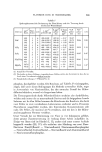
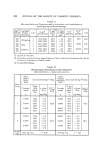
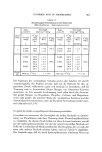
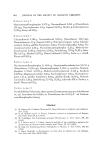
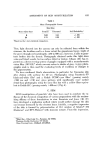
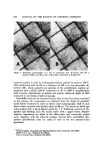
584 JOURNAL OF THE SOCIETY OF COSMETIC CHEMISTS Table I f-t-c of Beard Hair Cross-Sectional Area mm" x 10 4 Cutting Force in (g) Slope (g/mm'") Subject ñ Std Error 4- Std Error ___ Std Error JM(a) 122 ñ 3.9 3.93 ___ 0.23 322 -4- 9.7 (b) 147 ñ 6.2 4.85 4_-_ 0.33 339. ___ 15 RR(a) 99 ___ 2.1 4.43 ___ 0.09 445 ñ 7.7 (b) 94 ñ 4.9 3.36. ñ 0.07 358 ñ 14 JL(a) 115 ___ 5.3 4.49 ñ 0.11 3•9 + 15 (b) 89 ___ 3.4 4.40 ñ 0.10 494 ___ 24 JS(a) 142 + 9.3 4.52 ñ 0.18 318 ñ 17 (b) 160'___ 10.5 4.56 ñ 0.11 285 ___ 21 DD(a) 82 ___ 5.8 4.50 ___ 0.22 550 ñ 45 (b) 121 ñ 1.2 3.67 4- 0.09 303 ___ 4.4 ,(c) 96 ñ 2.3 4.6'8 + 0.12 487 ñ 11 f-t-e is about 4 per cent. Since the errors are of the same order of magnitude, there appears to be no need to utilize the time-consuming determination of the cross-sectional area. Instead, the f-t-c suffices for all practical purposes. F-t-c versus Rate o[ Cutting In order to determine how the speed of travel of the blade through the fiber affects the f-t-c, two fibers were cut at 5 different cutting rates varying be- tween 0.1 in./min to 50 in./min. Although there is a spread in the data (Fig. 4), linearity is assumed over the range studied. For practical purposes, it appears that the f-t-c increases significantly as the rate of cutting is increased. It is noted that a rate of cutting of 50 in./min approaches normal shaving conditions. Nevertheless, the much slower rate of 0.5 in./min was routinely used here in order to avoid the time-consuming complication of employing a storage oscilloscope. Effect of Moisture on Cutting Force It is an axiom of shaving tradition that the presence of water facilitates shaving and reduces discomfort. This tradition finds scientific support in the observations that the shear and tensile moduli of keratin fibers are functions of the relative humidity (5) and that hair is appreciably weakened by com- plete hydration. The influence of relative humidity on the f-t-c was established by condi- tioning beard hairs at various humidities and cutting them at that humidity in an environmental chamber positioned on the Instron Tester. The cutting forces (normalized to the value at 0 per cent R.H.) are plotted in Fig. 5, which also includes curves for the shear and tensile moduli computed from

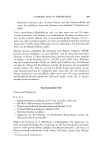
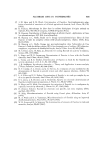
CUTTING OF BEARD HAIR 585 50- 45- 40- '•' 35- • 30- c-- 0•.,, .• )5- o 20- 15- 10- x x o o x x o-o Fiber 1 x-x Fibee 2 1 2 3 4 5 6 7 8 9 10 Force to Cut (g) Figure 4. Cutting rate vs. cutting force (cantilever) the data of Mitchell and Feughelman (5). The fact that the cutting force is less dependent on relative humidity than the shear or tensile modulus sug- gests that these moduli-even at a rate of 0.5 in./min-are not the predomi- nant factors in beard hair cutting. Instead, the f-t-c might be more closely related to stress propagation or to the creation of new surface area, than to the viscoelastic properties of the fiber. Hollander and Casselman (1) made creep measurements on scalp hair, which they then extrapolated to beard hair, to determine the rate of softening
Purchased for the exclusive use of nofirst nolast (unknown)
From: SCC Media Library & Resource Center (library.scconline.org)